Written by Alondra J Mendez- Guerrero and Bernardita Sallato, Washington State University, March 2026
Introduction
Across Washington apple industry, changes in cultivar demand, orchard age, and productivity continues to drive orchard replanting decisions. Large-scale growers typically replant 5-10% of their acreage each year to remain competitive and high productivity.
Orchard renovation generally begins with tree removal followed by soil preparation for replanting the new orchard. Most common tree removal starts with whole-tree excavation, removal of trellises and wires if present, piling and burning. To a lesser extent, some growers will do on-site chipping, or chipping and hauling (Groenier, 2008). While pile and burn appear one of the most economical alternatives, it is negative to the environment, results in carbon and nutrient (mostly N) loss and potential negative impact on soil health.
Following the tree removal, soil fumigation is commonly used to reduce plant-parasitic nematodes, fungi and bacteria (EPA, 2012). However, increasing interest in soil health, soil biology and regenerative practices has led Washington tree fruit growers to try alternative strategies for tree removal and replating.
The use of organic amendments such as compost, manure, and biochar is increasingly being used during orchard renovation to improve soil health, recycle nutrients, potentially suppress soilborne pests and increase orchard sustainability. These practices can alter soil biological communities, nutrient and water availability, improve soil physical conditions, all of which can alter orchard establishment and long-term orchard health.
The objective of this study is to evaluate how different soil amendments influence soil health indicators, soil biology, and early tree growth in a replated commercial apple orchard. This report summarized preliminary results from the 2025 growing season.
Methods
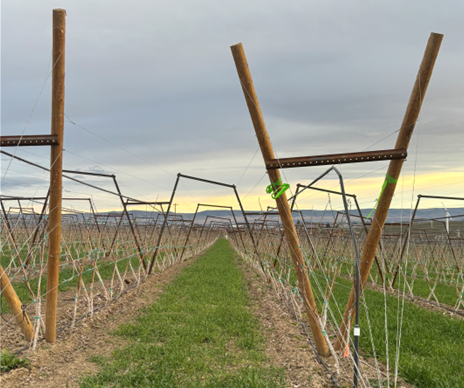
This study was conducted on a 14-acre block near Grandview Washington, (46°18’23.7″N 119°54’04.9″W). The previous apple orchard was removed in the fall of 2023, fumigated, and replanted in the spring of 2024 with ‘Firestorm ™ Honeycrisp’ cultivar on Bud 118 rootstock. Six soil amendments were applied in the spring of 2024 to a minimum of one acre each (Table 1).
Table 1. Soil amendments, application method and rate.
| Treatment | Application | Rate |
|---|---|---|
| Compost | Spread along the tree row | 4 tons/ acre |
| Straw Biochar + Manure | Straw Biochar 2′ wide and 6″ deep; Spread center of tree row | Biochar: 8 cubic yards/ acre; Manure: 10 tons/ acre |
| Woodchip + Sludge | Woodchips Broadcasted 2-3 inches; Sludge Banded along tree row | Woodchip at 65 tons/ acre; Sludge at 17 tons/ acre |
| Woodchip + Manure | Woodchips Broadcasted 2-3 inches; Manure Spread along tree row | Woodchip at 65 tons/ acre; Manure at 10 tons/ acre |
| Wood Biochar + Manure | Wood Biochar 2′ wide and 6″ deep; Spread center of tree row | Biochar at 8 cubic yards/ acre; Manure at 10 tons/ acre |
| Wood Biochar + Sludge | Wood Biochar 2′ wide and 6″ deep; Sludge Banded along tree row |
Biochar at 8 cubic yards/ acre; Sludge at 17 tons/ acre |
Tree growth measurements were obtained from sets of three trees in six pseudo-replicated sites per treatment (n=108 trees) (Figure 2). Soil samples were collected randomly prior to the treatment application and yearly after the treatments from six sites per treatment and sent for soil health and standard soil chemistry analyses. . In 2025, nematode analysis was included (Figures 3).


Preliminary results
Tree growth
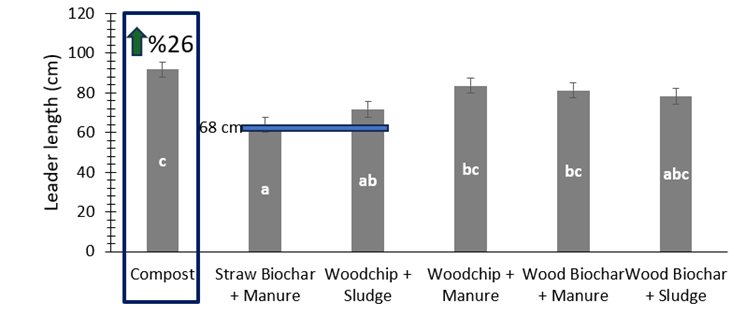
- Trees receiving compost were 26% taller than straw biochar + mature and woodchip + sludge treatments, averaging 91.8 cm(Figure 4). But with no differences with woodchip + manure and both of the wood biochar treatments.
- Straw biochar + manure and woodchip + sludge resulted in smaller trees, averaging 67.8 cm.
- However, trees receiving wood biochar + sludge had 39% greater lateral shoot growth, averaging 48.8cm.
Nematode population
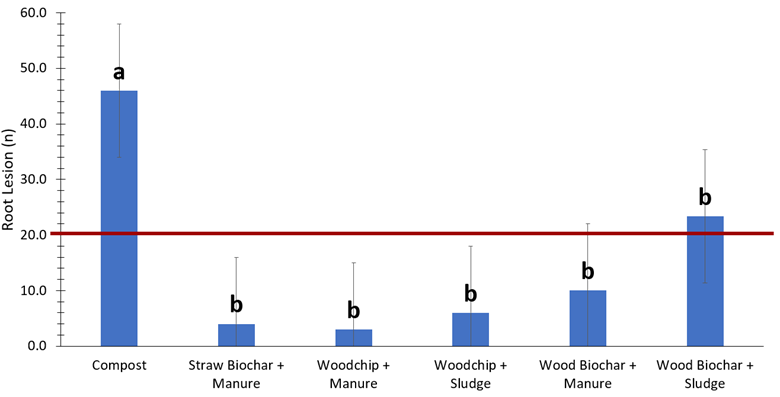
- Compost treated sites had 4 times more root lesion nematode counts (Pratylenchus penetrans and P. vulnus) averaging 46 counts per 100 g of dry soil. While all other treatments were below 9 counts per 100 g of dry soil.
- According to the PNW Plant Disease Management Handbook (2025), root lesion nematodes population above 20 per 100 g of dry soil, may cause damage in newly established trees.
Summary
Overall, by the second growing season, compost amendment favored strong vertical growth, while wood biochar + sludge favored lateral branching. Despite exceeding the advised threshold on nematodes counts, compost treated trees showed greatest vegetative growth and no visible decline symptoms in 2025.
These preliminary results suggest that compost can support strong vegetative growth even when parasitic nematode counts were high, possibly due to higher nutrient availability (data not shown) under compost amendment, higher root growth compensating for nematode potential damage, improved soil water retention. It is unclear whether sustained high populations could affect long-term productivity of the orchard.
Woodchips complemented with nitrogen sources (sludge or manure) did not show an impact on tree growth, generally associated with nitrogen immobilization, when compared with biochar treatments.
We will continue monitoring soil and tree health differences and how these practices can influence long-term orchard performance, along with the assessment of economic and environmental benefits.
Acknowledgments
Washington State Department of Agriculture – Specialty Crop Block Grant for their funding support, Farmland Management for support our research providing the experimental and demonstration site.
Contact
 Bernardita Sallato
Tree Fruit Extension Specialist
b.sallato@wsu.edu
References
Apple (Malus spp.)–Nematode, Root-lesion. 2025.
https://pnwhandbooks.org/plantdisease/host-disease/apple-malus-spp-nematode-root-lesion
Environmental Protection Agency. 2012. Soil Fumigation Manual. Environmental Protection Agency. Available at: National Soil Fumigation Manual https://www.epa.gov/system/files/documents/2023-11/soil-fumigation-manual-2012.pdf
Groenier, J. S. 2008. Removing slash mats (Tech Tip No. 0851-2312-MTDC). U.S. Department of Agriculture, Forest Service, Technology & Development.