Written by Dattatray Bhalekar, Juan Munguia de la Cruz, Bernardita Sallato, Lav Khot, Washington State University, March 2026
Precision crop load management is critical in modern apple production, enabling growers optimize fruit count, size, and quality while improving the efficiency of inputs. Recent advances in ground-based digital vision systems have expanded growers’ ability to monitor crop load dynamically at larger spatio-temporal scales. Kang et al. (2025) evaluated a precision chemical thinning method in a ‘Fuji’ apple orchard that combined the Vivid XV3 Vision System with a variable-rate sprayer, the Intelligent Spray Application (HSS, The Netherlands). The trials compared three approaches: precision treatment, conventional uniform spraying, and untreated control. A vehicle-mounted XV3 Vision System mapped fruitlet density per tree, and this data guided real-time chemical applications through a GNSS-enabled spray system. Both the precision and conventional treatments achieved similar reductions in fruit density and comparable fruit size at harvest. However, the precision approach used about 18% less thinning chemical.
In Washington State, the WSU Smart Apple Orchard team has been validating commercially available crop load monitoring technologies. In 2024 season, we reported that Vivid Machines estimated fruit size more accurately than blossom clusters or fruit counts, with errors decreasing once fruit diameter exceeded 20 mm, i.e., mid- to late season in a Cosmic Crisp® and Honeycrisp orchards. Higher estimation errors in Honeycrisp likely reflected block variability (Bhalekar et al., 2025). In this article, we explain Vivid XV3 Vision System and summarize the results obtained for the 2025 growing season in cv. Envy block.
Technology
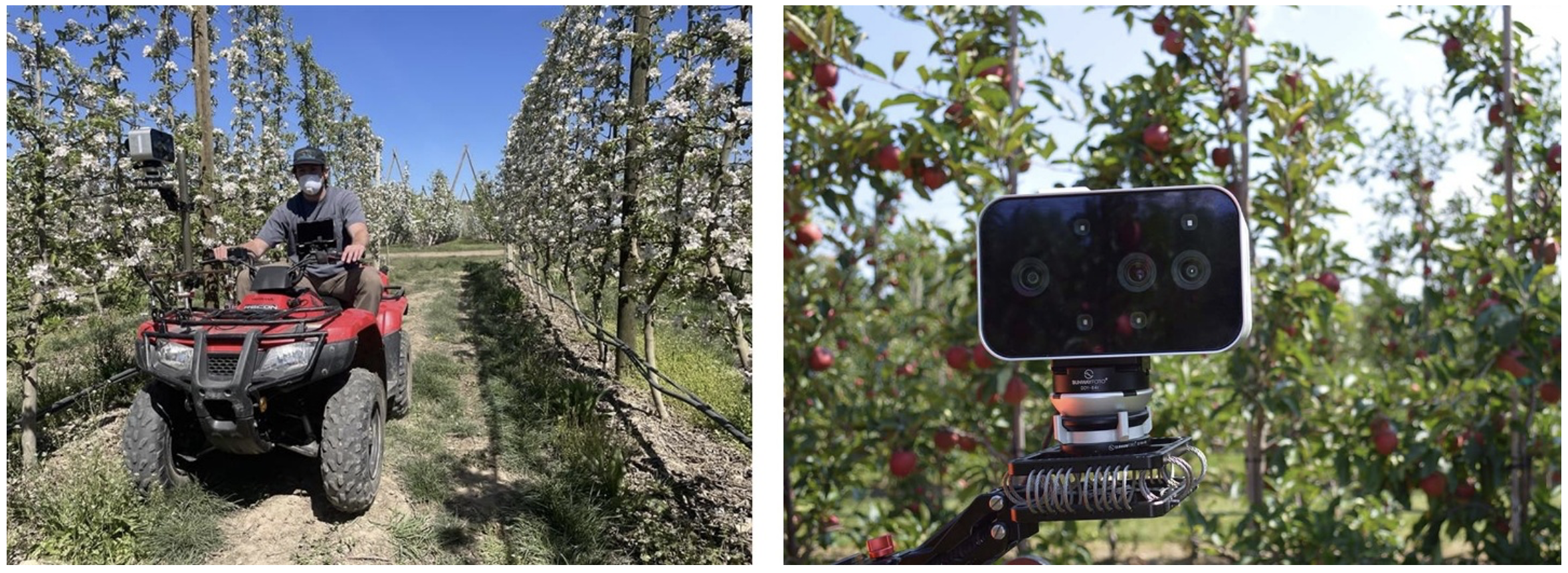
The Vivid XV3 Vision System uses a multispectral sensor to capture multiple bands in the visible and near-infrared (VIS-NIR) spectral range, a GPS receiver, and an integrated proprietary data processing algorithm. The system can be universally mounted on any farm vehicle to scan the block at 5-10 mph (Figure 1). Vivid Machines claims that the onboard vision system can scan, process, and provide real-time estimates for up to 20,000 trees/hour.
Evaluation Methods
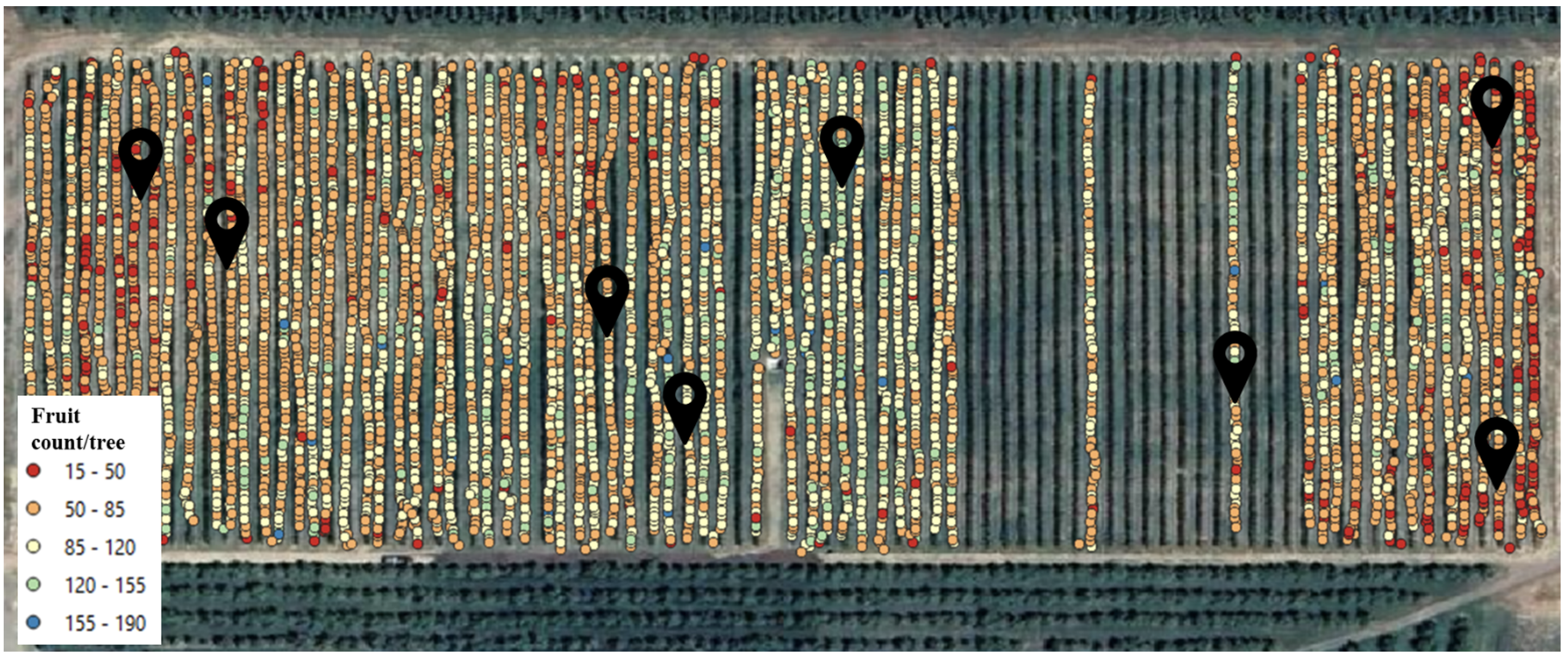
Eight data collection sites (Figure 2) representing low to high blossom density were chosen within a WSU Smart Apple Orchard Testbed at Zillah, WA. This 8.9-acre Envy apple block was planted in 2021, with trees spaced 10 × 4 feet. Throughout the season, five trees per site were monitored for blossom count (on April 18), and fruit size and count at key growth stages. Additional mapping campaigns were conducted on June 5, July 22, August 28, and October 15, 2025. During the last two mapping campaigns, two consecutive scans were performed on the same day to assess the repeatability of the data collection by the vision system. The averaged ground-truth data were compared with the average count and size estimates provided by the vision system for selected sites, using Absolute Percentage Error (APE, Bhalekar et al., 2025).
Key Results
- Blossom clusters estimated per tree by Vivid Machines (197.7 ± 70.5) were 24% higher than the ground truth counts (158.9 ± 124.4).
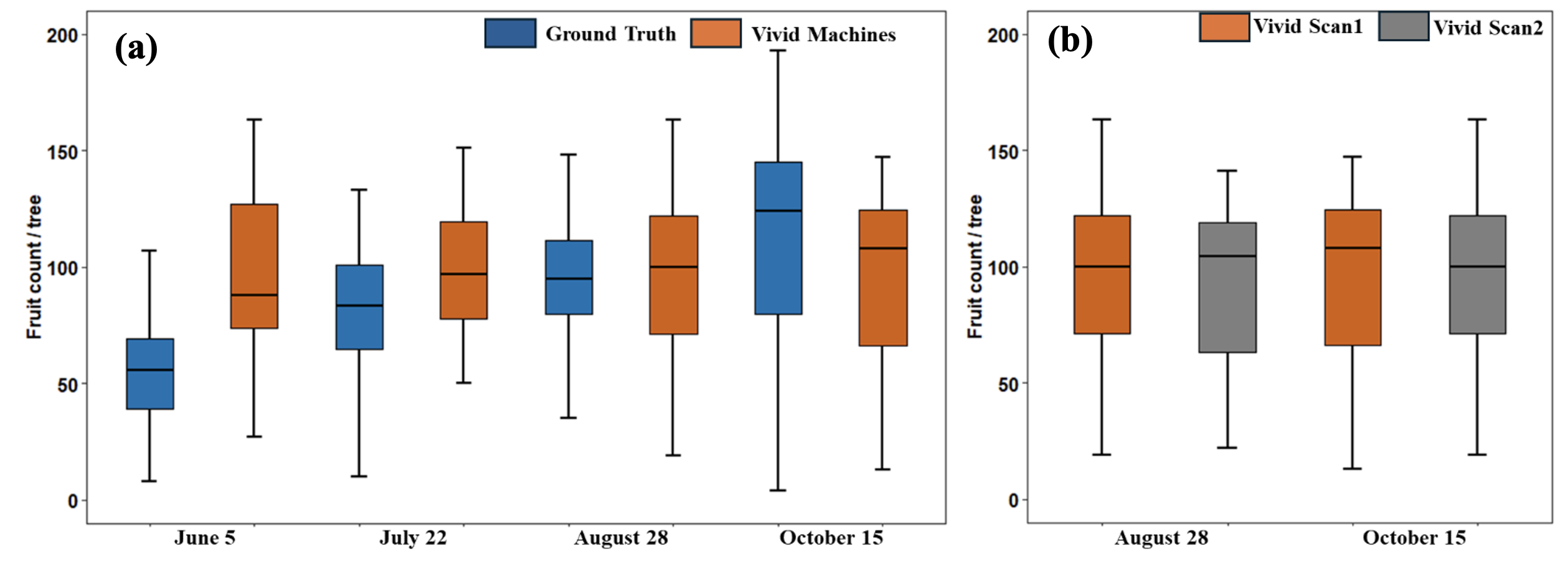
- Fruit count estimation accuracy improved as the season progressed. By harvest, the absolute percent error in fruit count estimates had reduced to 5%. (Figure 3a).
- Consecutive scans, conducted on August 28 and October 15, demonstrated strong repeatability in fruit-count estimates, with APE ranging from 1.7% to 4.2% (Figure 3b).
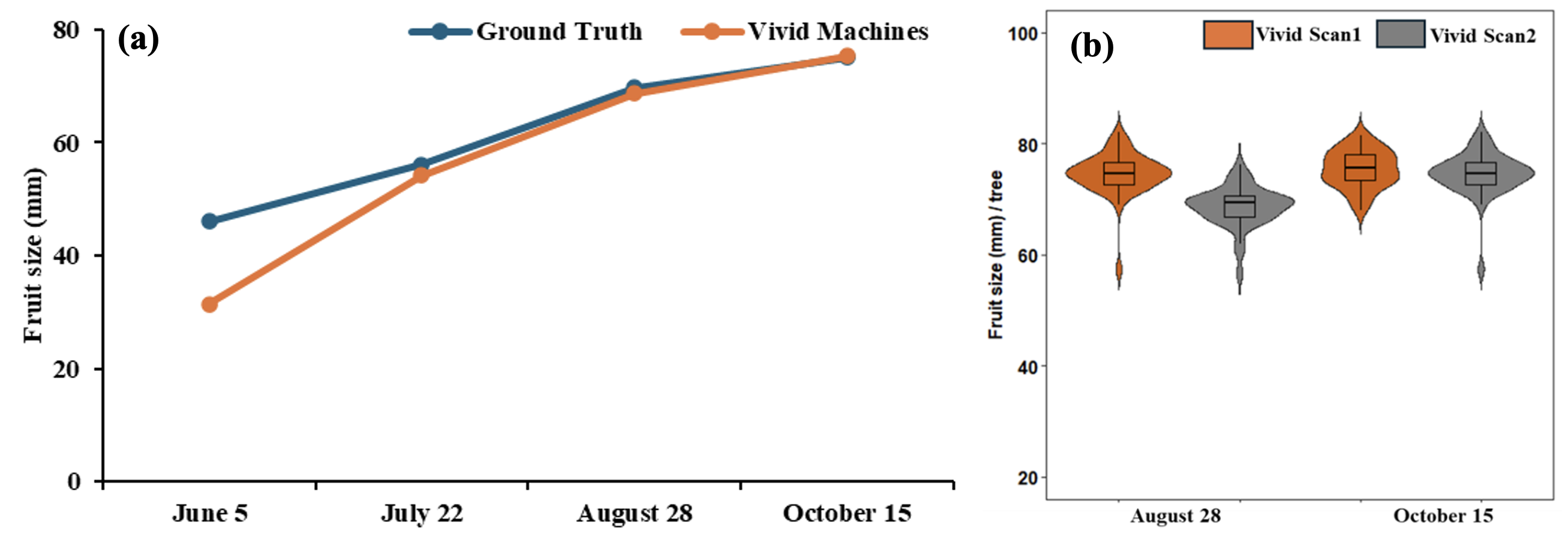
- Regarding fruit size, the estimates also improved as the season progressed, starting with an APE of 32% early in the season (fruit size < 40 mm) to less than 1% error in the pre-harvest scanning. Also, the repeatability of fruit size estimation between two consecutive scans was strong, particularly at pre-harvest (≤ 2% error).
Summary
The Vivid XV3 Vision System enables rapid, high-throughput measurement of crop load across multiple phenological stages, with improved accuracy as the season progressed. This technology provided accurate, repeatable information for crop-load management decisions at the Smart Apple Orchard testbeds. Based on our results, validating the counts during early stages of monitoring, when fruit are smaller than 40 mm, is recommended for thinning decisions. Vivid Machine system driven crop load monitoring can reduce reliance on labor-intensive hand counts, improve representation of the orchard and enable consistent orchard-scale decision making, helping optimize yield and fruit quality in Washington’s high-value apple industry.
Contacts

Dattatray Bhalekar
WSU Tree Fruit Extension Educator,(Horticulture Technology)
(509) 778-8646
Bernardita Sallato
Associate Professor
WSU Tree Fruit Extension
(509) 439-8542
 Lav Khot
Professor of Precision Agriculture
WSU CPAAS and AgWeatherNet
(509) 786-9302
Funding and acknowledgements
These efforts are funded by the Washington Tree Fruit Research Commission (WTFRC). Authors would like to extend sincere appreciation to Vivid Machines Inc. team for their collaboration and in-kind mapping campaigns at Smart Apple Orchard Testbeds. We would also like to thank grower cooperators, Northwest Farm Management LLC.
Additional Reading
Bhalekar, D., Munguia de la Cruz, J., Sallato, B., Khot, L., Meyer, M., Hanrahan, I., & Schmidt, T. (2025). Digital technology for precision apple crop load monitoring in Washington orchards. https://treefruit.wsu.edu/article/digital-technology-for-precision-apple-crop-load-monitoring-in-washington-orchards/
Kang, C., Kumar, S. K., & He, L. (2025). Integrating computer vision and precision sprayers for targeted green fruit chemical thinning. Precision Agriculture, 26(5), 86.
Disclaimer: The vendors listed in this document are provided for informational purposes only and are not exhaustive. Washington State University Extension and AgWeatherNet does not endorse, recommend, or promote any vendor.