Written by Katherine Dougherty, Cory Outwater and George W. Sundin, Michigan State University as proceedings for the Fire Blight Fruit School February 24, 2026.
Shoot blight is a symptom of the infection of vegetative shoots by fire blight bacterium Erwinia amylovora. E. amylovora can multiply and move quickly through shoots to the central leader and down to the rootstock crown. The implementation of high-density planting systems has led to an increase in tree mortality due to the close-proximity of vulnerable new-growth to the central leader. Without any major treatment recommendations, it is critical to gain a better understanding of the growth and migration of E. amylovora during shoot blight infections.
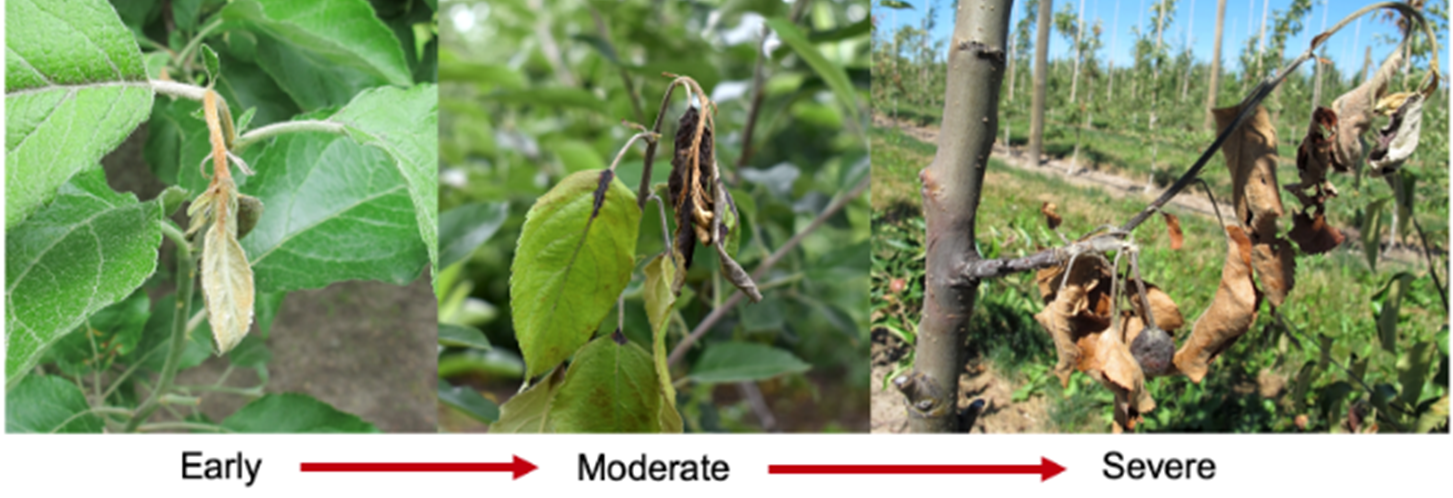
Shoot blight symptoms?
E. amylovora requires wounds to enter the leaves at shoot tips and initiate an infection. The pathogen may enter the host via wind, rain, or insects. Young, vigorously growing shoots are the most vulnerable to infection.
Early signs and symptoms of shoot blight:
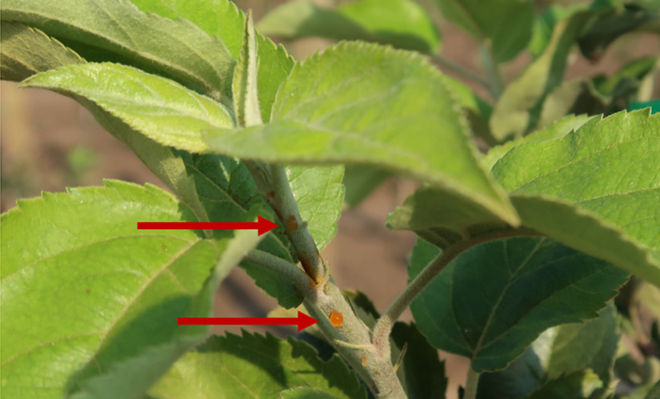
- White/orange/red ooze droplets;
- Development of orange color at the shoot tip.
Moderate symptoms:
- Wilting and necrosis of leaves at the shoot tip;
- Mid-vein necrosis of uncurled leaves;
- Dark lesion forming on the new growth.
Severe symptoms:
- Complete necrosis of the entire shoot;
- Ooze and wilting of surrounding shoots;
- Dry, crispy leaves with a canker forming adjacent to the infected shoot on the wood.
Abbreviated methods
We quantified and tracked E. amylovora migration through infected shoot tissues to gain insight into the systemic movement of the pathogen. Bacterial populations were monitored over a 20-day period in 4th-leaf ‘Gala’ trees in the field. Each shoot was sampled at the shoot tip, end of the new growth, beginning of the 2nd year wood, and at the branch/trunk junction to assess E. amylovora population density. Four experiments were conducted over the 2021 and 2022 growing seasons at the Michigan State University research orchard.
How does E. amylovora multiply in shoot blight?
- Our data shows that E. amylovora can rapidly reach populations > 1 billion cells per gram in the shoot tip before symptoms develop.
- E. amylovora can persist in high populations over long periods of time (>20 days) during periods of warm, wet weather.
How does E. amylovora move through the shoot?
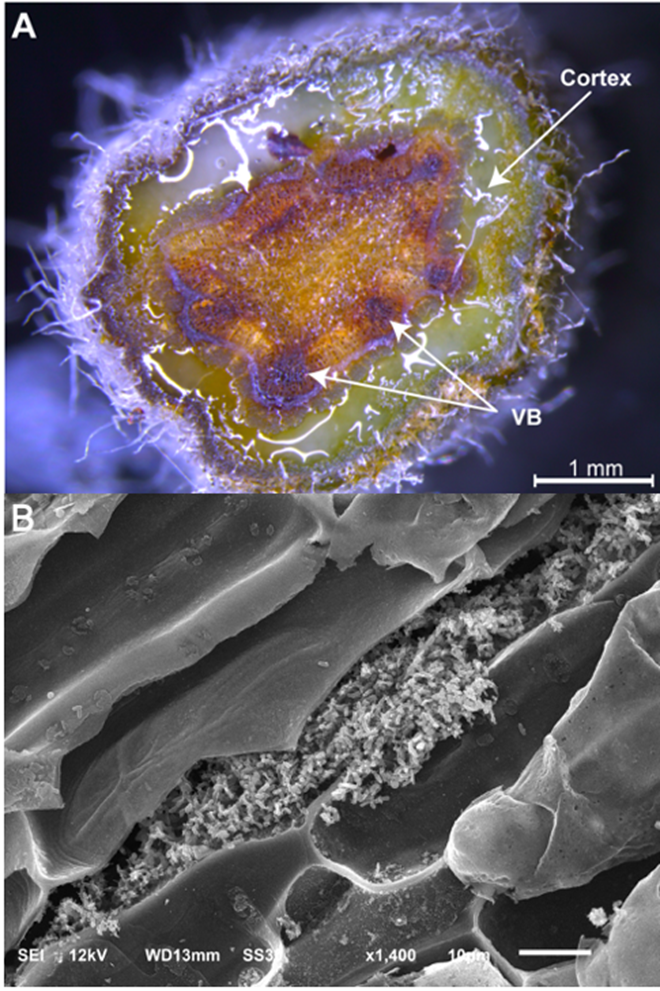
- E. amylovora moves through the cortex (tissue between the epidermis and the vascular bundles).
- It utilizes rapid bacterial growth and production of ooze to burst through plant cells laterally or through the epidermis as ooze.
- It can also form biofilms and clog the xylem vessels as shown with leaf mid-vein necrosis.
How quickly can E. amylovora migrate through shoots?
- The average velocity of amylovora movement was 2 inches per day.
- The maximum velocity detected was 4.5 inches per day (22.5 inches in 5 days).
- There were no differences in velocity between the new growth and woody tissue (P>0.05).
- E. amylovora cells were detected in the beginning of the wood (average new growth length approx. 8 inches) one week after inoculation with little to no symptom development.

Conclusions
Our data shows that E. amylovora can move at a speed of 2 inches per day and can go unnoticed during the early stages of infection. Persistence of high E. amylovora populations in shoot tissue over weeks at a time can increase the risk of secondary infections within a growing season. Rapid growth and migration of E. amylovora in shoot blight emphasizes the need for preventative treatments (Prohexadione-Ca and Actigard) and a consistent pruning regimen. This combination can eliminate future inoculum from the field and prevent tree death.
Additional information
Fruit Matters articles may only be republished with prior author permission © Washington State University. Reprint articles with permission must include: Originally published by Washington State Tree Fruit Extension Fruit Matters at treefruit.wsu.edu and a link to the original article.