WSU-USDA researchers following tree growth and yield at apple replant sites for six years after applications of Brassicaceae seed meal and anaerobic soil disinfestation found that biorenovation-treated fields generally had higher yield than untreated fields.
Highlight from ‘Multi-year effects of Brassicaceae seed meal and anaerobic soil disinfestation treatments on apple tree growth and yield at replant orchard sites’. S.T. DuPont, M. Mazzola, S. Hewavitharana, A. Baro, T. Somera. 2026. Journal of Agriculture and Food Research. Volume 28, 102975.
The soil borne pathogen and nematode complex that causes apple replant disease can stunt trees and reduce yields costing growers $5,000 to $170,000 in reduced returns during just the first four years of production [1-3]. Washington growers generally fumigate to prevent replant disease using a formulation of 1,3-dichloropropene and chloropicrin. But fumigation typically only provides short-term benefits. Growers asked for alternatives that provide longer term benefits, allow them to maintain their organic status (more than 27,000 acres of organic apples in Washington), and maintain active soil biological communities [4]. Alternatives will also benefit regions where registered pre-plant fumigants are not available (e.g. Canada, Pennsylvania).
In the first field-scale trial of biorenovation in apples, we found that Brassicaceae seed meal biorenovation and anaerobic soil disinfestation shifted the rhizosphere microbiome and resulted in initial tree growth as great or greater than fumigation [5]. In a recent study published in the Journal of Agriculture and Food Research we followed up to report the multi-year impacts soil treatments on tree growth, yield and profits [6].
What is biorenovation?
In Brassicaceae seed meal biorenovation, the residue that remains after oil extraction from mustard seeds is tilled into the soil results in release various biologically active compounds. These products are derived from the interaction between the mustard plant compound glucosinolate with a plant enzyme (myrosinase). These products (isothiocyanates) suppress soil borne pathogens and can select for beneficial microbes. Anaerobic soil disinfestation is a process where organic carbon sources are added to the soil, the soil is flooded using irrigation and then covered with a gas impermeable plastic film for several weeks. During the anaerobic decomposition process, microbes flourishing in the low oxygen/ high carbon environment generate volatile antimicrobial compounds (organic acids, alcohols, hydrocarbons, and alkyl sulfides) and increase the activity of microbes with biological control activity.
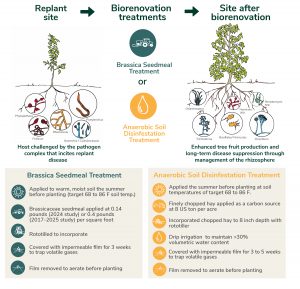
Figure 1. Apple replant disease caused by soil borne pathogens and nematodes stunts trees and reduces growth (left). After brassica seed meal or anaerobic treatments (bottom) long term disease suppression enhances tree fruit production (right).
Brassicaceae biorenovation steps
- Applied to warm, moist soil the summer before planting (target 68 to 86 °F; 75 to 80 °F this study)
- Brassicaceae seedmeal applied at 0.4 pounds per square foot (this study), 0.14 pounds per square foot (new study established in 2024)
- Rototilled to incorporate
- Covered with impermeable film immediately for 3 weeks to trap volatile gases
- Film removed to aerate before planting
Anaerobic soil disinfestation steps
- Applied the summer before planting at warm soil temperatures (target 68 to 86 °F; 57 to 80 °F this study)
- Finely chopped hay carbon source at 8 US tons per acre
- Incorporated chopped hay to 8 inch depth with rototiller
- Drip irrigation to maintain >30% volumetric water content (irrigation pulsed new study established in 2024)
- Covered with impermeable film for 5 weeks to trap volatile gases
- Film removed to aerate before planting
Figure 2. Steps to Brassica seed meal bio-renovation.
Step 1. Apple Brassica seed meal when soils are warm.

Step 2. Incorporate mixing well.

Step 3. Totally impermeable film.

Step 4. Treatments for 3 weeks.
Leave TIF in place for 3 weeks.
Step 5. Aerate soil 3 weeks or more.
Remove TIF and allow soil to aerate. Volatile compounds from bio-renovation are phytotoxic. Bio-renovation was performed the fall before planting.
Figure 3. Methods for anaerobic soil disinfestation (AASD) employed at three field sites in WA.
Step 1. Carbon source from grass cover crop or hay 8 to 10 ton per acre.


Step 2. Chop carbon material into small pieces.

Step 3. Incorporate.

Step 4. Tarp with TIF.

Step 5. Maintain soil moisture.

Step 6. Remove TIF and aerate.
Soil was allowed to aerate 3 weeks. Compounds released during anaerobic conditions can be phytotoxic.
Impact of biorenovation on yield
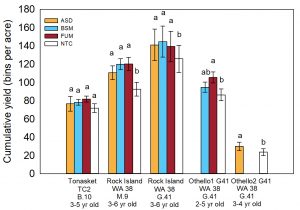
In the Journal of Agriculture and Food Research [6] we reported tree growth and yield impacts of these biorenovation strategies up to six years after planting. Trees grown in soil amended with the Brassicaceae seed meal formulation (1:1) of Brassica juncea and Sinapis alba resulted in higher annual and cumulative total yield than no-treatment controls in two of four location-rootstock comparisons (Figure 2). Annual total yield increases from Brassicaceae seedmeal amended soil compared to no-treatment control varied from 13% (Rock Island, WA location with WA 38 on G.41 rootstock) to 28% (Rock Island, WA location with WA 38 on M9.337 rootstock). In comparison, fumigation yield increases ranged from 14 to 30% compared to no-treatment control. Trees grown in anaerobic soil disinfestation treated soils resulted in higher annual yield in four of four location-rootstock combinations and higher cumulative yield in three of four location-rootstock combinations relative to no-treatment controls. Annual yield increases compared to no-treatment control of anaerobic soil disinfestation ranged from 14% (Rock Island location planted to WA 38 on G.41 rootstock) to 26% (Othello2 location plated to WA 38 on G.41 rootstock).
Return on investment
At rates used in this trial yield benefits of Brassicaceae seed meal application compared to fumigation did not outweigh increased costs over the five- to six-year period of these experiments (Table 1). However, if applied at reduced rates currently under testing, return on investment is comparable to fumigation.
Table 1. Summary of return on investment at Rock Island WA 38 on M9.337 rootstock.
| Treatment | Fumigation | Brassicaceae seed meal application this trial a | Brassicaceae seed meal application reduced rate c | Brassicaceae seed meal application reduced rate d |
|---|---|---|---|---|
| Application cost per acre | $900 | $5900 | $2758 | $2500 |
| Increased yield cumulative bins per acre 3 to 6-year-old trees | 27.8 | 27.4 | * | * |
| Increased revenue per acre | $7500 | $7398 | * | * |
| (to no-treatment) b | ||||
| ROI per acre | $6600 | $1498 | $4640 | $4848 |
a At rates used in this trial (0.4 pounds per square foot, at $0.85 per pound) plus materials and labor [5].
b At returns of $270 per bin (assuming 70% marketable fruit) [7].
c Reduced rate found to be effective in more recent trials [8] of 1 kg m2, 4.4 t ha-1 applied to 42% treated area (0.2 pounds per square foot).
d Reduced rate used in trial initiated in 2024 of 0.14 pounds per square foot, 3 US tons per acre or 1.5 US tons per acre applied to the five-foot wide tree row only at 10-foot spacing (0.66 kg m2, 6.6 t ha-1, 3.3 t ha-1 when applied to the tree row only).
*Assuming increased yield and returns remained consistent.
![Figure 5. Effect of soil treatments on tree size measured as tree diameter (mm) at 20 cm above the graft union. Figure reprinted from DuPont et al 2026 with author permission. Not for re-distribution. Note: BSM = Brassicaceae juncea-Sinapis alba seed meal; ASD = anaerobic soil disinfestation; NTC = no-treatment control; FUM = fumigation. (Reprinted from [5].)](https://s3.us-west-2.amazonaws.com/treefruit.wsu.edu/wp-content/uploads/2026/09/04133547/Figure-1-789x1024.jpg)
Figure 5. Effect of soil treatments on tree size measured as tree diameter (mm) at 20 cm above the graft union. Figure reprinted from DuPont et al 2026 with author permission. Not for re-distribution. Note: BSM = Brassicaceae juncea-Sinapis alba seed meal; ASD = anaerobic soil disinfestation; NTC = no-treatment control; FUM = fumigation. (Reprinted from [5].)
Tips for Growers
Brassicaceae seed meal bio-renovation is looking promising as an alternative to fumigating with 1,3-dichloropropene, chloropicrin. If used in the future, keep in mind that not all brassica seed meals are equal. The seed meal used here was a 1:1 formulation of Brassica juncea and Sinapsis alba [2]. Seed meals are often processed at different temperatures and with different grinding methods which affect the quantity of active chemistry that is released. Tests should be conducted to determine the type and quantity of glucosinolate contained in the seed meal that you intend to use. To date in the US, the Brassicaceae seed meal used here is labeled only as a fertilizer. Information supplied here are trial results only. Remember that soil temperature and moisture are important. These are biological processes where moisture and temperature affect the activity of soil biology and the movement through the soil of the compounds they produce. For Brassicaceae seed meal, treatment soil should be warm (best 68 to 86° F) and moist [9]. Last, application rates are important.
For successful anaerobic soil disinfestation, it will be essential to keep soil wet (above 30% moisture), apply when soils are warm (best 68 to 86° F) [10] , and reach anaerobic conditions for success. In sites with high Pratylenchus nematode populations, higher carbon inputs and longer incubation times might be necessary for success.
Resources
Totally Impermeable Film (TIF) Vaporsafe (Viaflex, Siox Falls SD) http://www.viaflex.com
Brassicaceae seedmeal 1:1 B. juncea: S. alba (Farm Fuels Inc., Watsonville, CA) https://farmfuelinc.com/
Plastic layer Mechanical Transplanter Co Model 90, Zeeland, MI
Supplementary tables with field operation details this experiment.
Publications Highlighted
DuPont, S.T., S.S. Hewavitharana, and M. Mazzola, Field scale application of Brassica seed meal and anaerobic soil disinfestation for the control of apple replant disease. Applied Soil Ecology, 2021. 166. DOI: 10.1016/j.apsoil.2021.104076
DuPont, S.T., M. Mazzola, S.S. Hewavitharana, A. Baró, T. Somera, Multi-year effects of Brassicaceae seed meal and anaerobic soil disinfestation treatments on apple tree growth and yield at replant orchard sites. Journal of Agriculture and Food Research, 2026. 28. 10.1016/j.jafr.2026.102975
Funding Sources & Acknowledgements
This project was supported by grants from the Washington State Tree Fruit Research Commission grant # 10211000 and the USDA Crop Protection grant # 2017-70006-27267. Thank you to in-kind support from Progen Seed, Trident Ag Products, Farm Fuel Inc and generous support of labor, materials, and equipment from orchardists Mike Robinson, Jim Baird, and Sam Godwin.
References
- Mazzola, M. and J. Brown, Efficacy of Brassicaceous Seed Meal Formulations for the Control of Apple Replant Disease in Conventional and Organic Production Systems. Plant Disease, 2010. 94(7): p. 835-842. DOI: 10.1094/pdis-94-7-0835
- Mazzola, M., S.S. Hewavitharana, and S.L. Strauss, Brassica seed meal soil amendments transform the rhizosphere microbiome and improve apple production through resistance to pathogen reinfestation. Phytopathology, 2015. 105(4): p. 460-469. DOI: 10.1094/phyto-09-14-0247-r
- Mazzola, M. and K. Mullinix, Comparative field efficacy of management strategies containing Brassica napus seed meal or green manure for the control of apple replant disease. Plant Disease, 2005. 89(11): p. 1207-1213. DOI:10.1094/pd-89-1207
- National Agricultural Statistics, N. Apples organic acres harvested Washington state census 2021. Quick Stats 2021 [cited 2024 April 1, 2024]; Available from: https://quickstats.nass.usda.gov/results/18A1050F-34A9-3910-8368-77116D3921DD.
- DuPont, S.T., S.S. Hewavitharana, and M. Mazzola, Field scale application of Brassica seed meal and anaerobic soil disinfestation for the control of apple replant disease. Applied Soil Ecology, 2021. 166. DOI: 10.1016/j.apsoil.2021.104076
- DuPont, S.T., et al., Multi-year effects of Brassicaceae seed meal and anaerobic soil disinfestation treatments on apple tree growth and yield at replant orchard sites. Journal of Agriculture and Food Research, 2026. 28. 10.1016/j.jafr.2026.102975
- Milne, B., Blakey, R., personal communication. Average returns for WA 38 from two major Washington packing houses 2020 to 2023., S.T. DuPont, Editor. 2024.
- Wang, L.K. and M. Mazzola, Field Evaluation of Reduced Rate Brassicaceae Seed Meal Amendment and Rootstock Genotype on the Microbiome and Control of Apple Replant Disease. Phytopathology, 2019. 109(8): p. 1378-1391. DOI:10.1094/phyto-02-19-0045-r
- Wang, L. and M. Mazzola, Effect of soil physical conditions on emission of allyl isothiocyanate and subsequent microbial inhibition in response to Brassicaceae seed meal amendment. Plant Disease, 2019. 103: p. 846-852.
- Shrestha, U., R. Auge, and D. Butler, A meta-analysis of the impact of anaerobic soil disinfestation on pest suppression yield of horticultural crops. Frontiers in Plant Science, 2016. 7: p. 26. DOI:10.3389/fpls.2016.01254
Contact
Tianna DuPont
WSU Extension Specialist, Tree Fruit
tianna.dupont@wsu.edu
(509) 663-8181 ext 211
Treefruit.wsu.edu articles may only be republished with prior author permission © Washington State University. Republished articles with permission must include: “Originally published by Washington State Tree Fruit Extension Fruit Matters at treefruit.wsu.edu” along with author(s) name, and a link to the original article.