Written by Srikanth Gorthi, Sanjita Bhavirisetty, Lav Khot, Lee Kalcsits, Washington State University, October 2026.
AgWeatherNet, with support from the Network for Environment and Weather Applications (NEWA) at Cornell University, has web ported the carbohydrate thinning model (Malusim). The model has been customized for Washington conditions. It uses orchard site attributes, station specific weather, and forecasts to output chemical thinning decisions.
Background
Chemical thinning is a critical management practice in apple production, where both application timing and rate are important for achieving the desired crop load. Research has shown that the carbohydrate supply available to the tree relative to the demand from developing fruit plays an important role in determining the tree’s response to chemical thinners. Tree sensitivity to thinning is strongly influenced by the balance between carbohydrate supply and demand. Several environmental and physiological factors are known to affect this balance, and the underlying processes are relatively well understood and have been modeled using process-based approach.
To better understand carbohydrate supply and demand in apple trees, the team at Cornell University (Lakso, Robinson, and Green (2007)) has developed and validated the carbohydrate balance model, Malusim, nearly three decades ago. This model has been tested and evaluated under a wide range of orchard and weather conditions. Malusim mechanistically estimates key physiological processes, including photosynthesis, respiration, and the growth demands of fruits, leaves, roots, and woody tissues. Using daily minimum and maximum air temperature and solar radiation as weather inputs, the model estimates daily carbohydrate production and the amount of carbohydrates available to meet the demands of different tree parts.
Originally, the model was not developed for a specific apple cultivar or training system. Instead, thinning recommendations are primarily related to the carbohydrate status of the tree. Under cool and sunny conditions, carbohydrate production is generally higher, and trees tend to be less sensitive to chemical thinners. In contrast, warm and cloudy conditions can reduce carbohydrate availability and increase tree sensitivity to chemical thinning and natural fruit drop.
Because tree response to chemical thinning is influenced by carbohydrate conditions over several consecutive days rather than by a single day, the current model uses a seven-day carbohydrate balance to estimate the thinning index. This period includes two days before thinner application, the day of application, and four days after application. Considering this multi-day period provides a more representative estimate of the carbohydrate conditions surrounding thinner application and, consequently, the potential sensitivity of the tree to chemical thinning.
Accessing the model through AgWeatherNet Portal
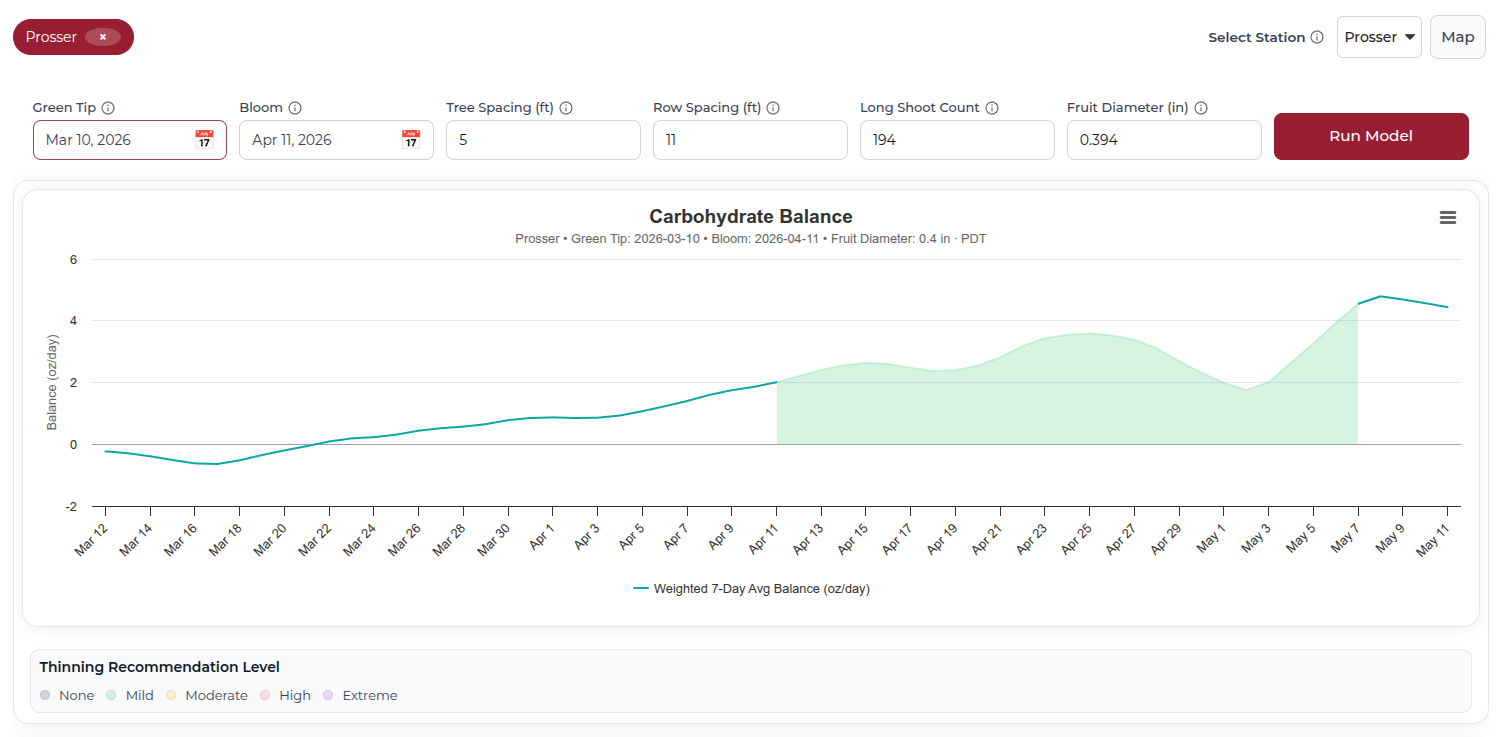
To access the model through the AgWeatherNet (AWN) web portal, users can navigate to the Models page and select Apple → Carbohydrate Thinning (MaluSim). Model can also be accessed directly through the Carbohydrate Thinning Model page. Users need to enter the green tip and bloom dates, and tree- row spacing for the orchard block (Figure 1). The model uses these inputs along with observed weather and 7-day forecast to estimate carbohydrate balance for the next seven days. Model also outputs corresponding chemical thinning recommendations using the carbon-balance thresholds presented in Table 1. Users can select the nearest AWN weather station or, when available, a private weather station installed within their orchard block.
Table 1. Carbon balance thresholds and corresponding chemical thinning recommendations used in the ‘Malusim’ model.
| 7-day average Carbon Balance (g/day) | Adjustment |
|---|---|
| Greater than 0 (Surplus) | Increase Chemical Thinner Rate by 30% |
| 0 to -20 | Apply Standard Chemical Thinner Rate |
| -20 to -40 | Decrease Chemical Thinner Rate by 15% |
| -40 to -60 | Decrease Chemical Thinner Rate by 30% |
| -60 to -80 | Decrease Chemical Thinner Rate by 50% |
| Less than -80 (Severe Deficit) | Do not thin (many fruits will fall off naturally) |
As part of our efforts to transfer and adapt Malusim model to Washington State conditions, we evaluated the sensitivity of model outputs to orchard-specific parameters. The analysis indicated that area per tree, calculated from tree and row spacing, and the number of long shoots influenced modeled carbohydrate balance. Under the most extreme parameter modifications evaluated, reducing area per tree from the default 5.1 m² (55 ft2) to 2 m² ((22 ft2) resulted in a different thinning recommendation on 24% of the evaluated recommendation days. Reducing the long shoot count from the default 194 to 25 resulted in a different recommendation on 4% of the evaluated days. However, the effects of these two parameters were not statistically significant in our analysis, and the other evaluated parameter values generally did not alter the final thinning recommendation.
The model generates thinning recommendations during the 30-day period following bloom and is available for use during the seasonal window from January 1 through May 30. The current implementation is independent of cultivar and training system.
As the model uses forecasted weather data to estimate future carbohydrate balance, users are encouraged to rerun the model when substantial changes in temperature, solar radiation, or other forecast conditions occur.
Contact
For feedback on the AWN web portal, write us at weather@wsu.edu.

Srikanth Gorthi
Postdoctoral Research Associate, WSU AgWeatherNet
srikanth.gorthi@wsu.edu

Sanjita Bhavirisetty
Application Systems Analyst/Developer, WSU AgWeatherNet
r.bhavirisetty@wsu.edu

Lav Khot
Director, WSU AgWeatherNet
lav.khot@wsu.edu

Lee Kalcsits
Professor, Endowed Chair of Environmental Tree Fruit Physiology and Management
Director, Wenatchee TFREC
lee.kalcsits@wsu.edu
Funding and acknowledgements
This model was ported into AWN with funding in parts from the WSDA Specialty Crop Block Grant (2023–2026, PIs: Lee Kalcsits, Lav Khot) and USDA NIFA SCRI (Precision Apple Crop load Management) projects. The Apple carbohydrate thinning model was originally developed by Alan Lakso and Terence Robinson at Cornell University. The Northeast Regional Climate Center and the NY Mesonet (with contributions from Keith Eggleston and Arthur DeGaetano) assisted in integrating this model into AWN. At Washington State University, AWN team (Basavaraj Amogi, Srikanth Gorthi and Sanjita Bhavirisetty) ported this model and Dr. Lee Kalcsits’ team is evaluating the model’s adaptability to Washington growing conditions and will help guide future updates.
Additional Reading
Lakso, A.N., Robinson, T.L., and Green, D.W. 2007. Using an apple tree carbohydrate model to understand thinning responses to weather and chemical thinners. NY Fruit Quarterly. 15 (3) pp 17-20.