Skip to main content Skip to navigation

Consumer Preferences for Pears

Consumer Preferences for Pears will be the topic of a session hosted by WSU and OSU on Tuesday, August 16th at 10:00 am. Carolyn Ross, Ann Colonna, and Karina Gallardo will discuss their extensive research conducted last winter with over 20 pear varieties. The aim of the work was to gain a greater understanding of which characteristics consumers in the Pacific Northwest prefer, what their willingness is to pay for these varieties and insights into consumer purchase behavior. Time is allotted for a question and answer session. Zoom details including the link are in the event notice on our website.

Please use this link to join the Zoom webinar.

Meeting ID: 898 1040 0942

Passcode: 526112

Contact:

Karen Lewis

Program Director, Agriculture and Natural Resources

kmlewis@wsu.edu

(509) 754-2011 ext 4307

Inerts in Mating Disruption Potentially De-listed – Opportunity to Comment

The National Organic Standards Board is reviewing inert ingredients which if lost could make pheremone mating disruption not available for organic. Please see the communication below from the Northwest Hort Council to make comments due April 5.

The NOSB is considering sunset review of List 3 Inert Ingredients used in mating disruption dispensers. Without List 3 inerts, pheromone disruption may be lost for use in organic. There is also a petition being considered to allow use of Kasugamycin to treat fire blight, and sunset review of several sanitizers/disinfectants used in both crops and handling. There is a concerted effort by some advocacy groups with influence on the board to use this review process to reduce the number of sanitizers available to the organic industry. Therefore, communicating the importance of maintaining each of these sanitizers is important to maintaining access to them in the future.

We would like to encourage folks across industry to use this NHC draft as a template for written comments they develop to describe their particular operation. Writers should individualize their comments to their own operations, referencing how your farm or packinghouse uses each material, and provide a summary of what material is used at each stage of the process in order to give the NOSB a full picture of how various materials are needed by each operation. We also suggest that you still list the other possible uses (i.e. still mention that PAA may be used to treat dump tank water, even if you don’t use it in that manner) to support the continued availability of these products for those purposes in the future.

NHC comments for consideration by the NOSB at their April 2021 meeting can be found at this url: https://nwhort.org/organics/ – scroll down to 2021 meeting information to the Click here for draft comments for consideration by the NOSB at their April 2021 meeting.’

While NHC will be submitting written comments in support of maintaining these products (and adding Kacugamycin to the National List) and staff will be providing oral testimony, the number of comments from growers and packers matters to the NOSB as they are considering renewal of these materials and comments from producers carry a lot of weight. This is why the NHC is encouraging organic growers and packers to submit their own written comments and consider signing up to provide a (virtual) three-minute statement via oral testimony.

Writers do not need to comment on every material or petition that the NHC commented on, just those of importance to their own operation, such as the potential loss of mating disruption should the NOSB vote to delist List 3 inert ingredients, or they could write in support of allowing the use of Kasugamycin in organic production.

In addition to List 3 inerts and Kasugamycin, materials up for sunset review by the NOSB include:

205.601 Sunsets: Synthetic substances allowed for use in organic crop production and handling (all except ozone, which is only under review for use in crops):

  • Ozone gas
  • Peracetic acid (§205.601(a)(6) & §205.601(i)(8))
  • EPA List 3 – Inerts of unknown toxicity
  • Chlorine materials
  • Calcium hypochlorite

(ii) Chlorine dioxide

(iii) Hypochlorous acid – generated from electrolyzed water

(iv) Sodium hypochlorite

  • 205.602 Sunsets: Nonsynthetic substances prohibited for use in organic crop production:
  • Calcium chloride

COMMENTS ARE DUE TO THE NOSB BY 11:59PM ET APRIL 5, 2021, AND SHOULD BE SUBMITTED VIA: Regulations.gov. (Docket # AMS-NOP-20-0089).

Oral Comments – 3 minutes
Oral comment registration is full, but we are told they will make every effort to hear your comments if you would like to be added to a waitlist. Do so by emailing michelle.arsenault@usda.gov by no later than April 16, 2021. The Board will hear oral comments during the following times via Zoom: Tuesday, April 20, and Thursday, April 22, 2021, from 12:00 – 5:00 p.m. Eastern


David Epstein, VP for Scientific Affairs

Northwest Horticultural Council

105 South 18th St, Suite 105

Yakima, WA 98901

epstein@nwhort.org

Office (509) 453-3193

Mobile: (509) 654-3713
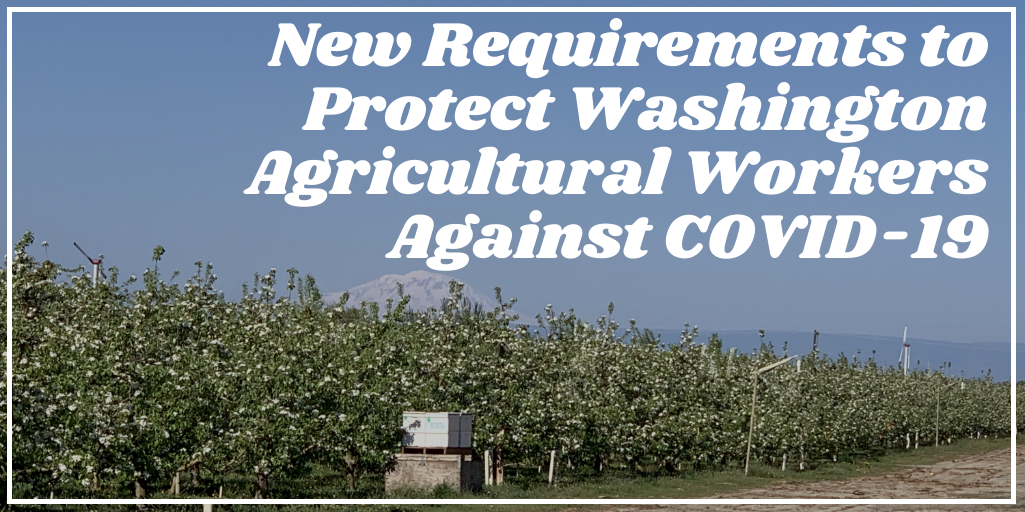
New COVID-19 Requirements for Washington Agriculture

Yesterday, Gov. Inslee released Proclamation 20-57, “Concerning the Health of Agricultural Workers” which provides required protections that must be in place by June 4. Full details of requirements can be found here: COVID-19 Agricultural Safety Plan (pdf).

There are several requirements detailed such as,

  • Mandated employee training, with key content that must be addressed through educational materials and training
  • Cloth facial coverings must be worn by every employee not working alone on the jobsite
  • Employers, operators, and providers must supply, at no cost to employees, all PPE mandated by these requirements, including gloves, goggles, face shields, and face masks. PPE must be clean and available each workday.
  • Required temperature check and symptom review at the beginning of each shift
  • Required disinfection of high touch surfaces at start of work, before and after morning break, lunch, and afternoon break
  • Requirement to document and maintain a COVID-19 Response Plan
  • For outdoor worksites, handwashing stations must be placed within 110 yards of employees at all times (this requirement is typically ¼ mi for GAP audit purposes)
  • For indoor worksites, employers are required to implement a physical distancing plan

This by no means covers everything.

During the press conference yesterday, L&I emphasized that growers/operators should use their consultation services to help address any questions they have with the new requirements.

WSDA Spray Drift Compliance Letters & Resources

An email was sent out the second week of May from the WSDA to licensed applicators. It highlighted new surveillance of off-target drift. If you would like to receive more information on how to reduce drift from your sprayers please see the following resources.

Personal contacts:

Gwen Hoheisel
Regional Extension Specialist
Washington State University
ghoheisel@wsu.edu
509-788-5459
Bradley Farrar
Pesticide Education & Outreach Supervisor
WA State Department of Agriculture
bfarrar@agr.wa.gov
509-249-6926

Online resources:

WSU Newsletter article: 6 steps to calibration and optimization

WSU Viticulture Website    WSU Tree Fruit Website     Ontario’s Sprayers 101 Website

This notice will also appear in our June Fruit Matters newsletter.

Produce Safety Alliance Grower Courses

The Washington State Tree Fruit Association will hold a Produce Safety Alliance Grower Training course on March 31st, in Yakima and an FSMA Produce Safety Alliance Integrated Training course on April 1st and 2nd in Wenatchee.

The PSA Grower Training is a one-day class that fulfills the FSMA Produce Safety Rule requirement for Produce Growers outlined in § 112.22(c) that requiresAt least one supervisor or responsible party for your farm must have successfully completed food safety training at least equivalent to that received under standardized curriculum recognized as adequate by the Food and Drug Administration.”

The PSA Integrated Training combines both the PSA Grower Training and the PSA Train-the-Trainer Course. By combining the training for growers and trainers on Day-1 of the workshop, trainers will have the opportunity to engage in discussions and learn from the questions that grower participants ask. Day 2 of the workshop will be for trainers only, focusing on adult learning techniques and additional presentations to ensure trainers are prepared to deliver the FSMA Produce Safety Rule modules to growers.

Click here to register online for the Tuesday, March 31st PSA training in Yakima.

Click here to register online for the Wednesday, April 1st and Thursday, April 2nd PSA Integrated Training Wenatchee.

These courses are subsidized by WSDA support through the Produce Safety Program. Registration fee will include the PSA Grower Training Manual, a certificate of course attendance issued by AFDO, lunch and refreshments. If you have any questions, please contact Jacqui Gordon, at 509-452-8555 or jacqui@wstfa.org, or Joanne Rouse, at 509-665-9641 or joanne@wstfa.org.

Pre-registration online is required, no on-site registration will be accepted. The Registration fee is non-refundable.

Agricultural Internship Opportunity with Mt. Adams Fruit

Mt. Adams Fruit has an agriculture intern position that provides exposure to the practical aspects of apple, pear and cherry growing.   This position is best suited for students interested in learning production agriculture leading to managing a fruit orchard.

Nestled at the foot of Mt. Adams in Washington State, Mt. Adams Fruit is a 1,600 acre progressive apple, pear and cherry orchard that sells and ships both conventional and organic grown fruit, worldwide, including Mexico and Asia.

If you are a college student interested in progressive agriculture and are studying the following programs then we want to talk to you.

  • Horticulture
  • Agriculture Economics
  • Agriculture engineering
  • Biology

Responsibilities/Duties:

  • Exposure and work with:
    • Apple, Pear and Cherry Thinning
    • Fruit Growth
    • Irrigation
    • Cherry Harvest
    • Entomology
      • Working with scouting crew
      • Pest management/spray program
      • Chemical SDS’
    • Fire Blight diagnosis and mitigation
    • Summer Apple Pruning
    • Employee Management
      • Basic employment law
      • Safety and Health
      • Spray program
      • Worker communication
    • Tree training
    • Shop Work
    • Office exposure
  • Orchard Food Safety
  • Other associated duties of an ag or business nature as directed by Orchard Superintendent

Physical demands and work environment

  • Excellent physical health and stamina
  • Ability to lift and/or move up to 50 pounds.
  • Ability and desire to work outside in all types of weather that is hot, dusty, humid, wet, cold and windy.
  • Ability to walk in varied terrain with topography up to 50 degrees inclination and declination

Experience and Education:

  • Must be currently enrolled in an agriculture or related college program with the goal to obtain a degree suitable to the management of an agribusiness
  • Strong interpersonal skills
  • Ability to be a self-starter and work independently or on a team
  • Basic knowledge of Microsoft Office including word and excel.
  • Ability to work with a diverse group of people.
  • Solid analytical skills
  • Excellent communication skills (oral and written)
  • Ability to solve problems in a practical manner
  • Ability to deal with a variety of changing situations

Hours: 40 hours per week at least, Mon. – Fri. 7:00 AM – 3:30 PM.  Work start and stop time may be earlier and/or longer depending on the available work and may last up to 50 – 60 hours a week.
Duration: June through September.  Mt. Adams Orchards is flexible with the start and end date depending on school schedule.
Pay: $14.00 per hour
Housing: Housing is provided for no cost during the time of employment.
Vehicle: Intern must provide own transportation.
Application
Deadline:
5/1/2020
Location: Mt. Adams Fruit
503 Oak Ridge Road,
White Salmon Washington 98672
To Appy: Applicants are encouraged to email a cover letter and resume outlining their current course of study and applicable experience they may have to:
Troy Frostad
troy@maocorp.com
Additional
Contact:
timothyp@maocorp.com

We strive to be a highly respected, innovative and profitable company.  We will create sustainable growth for our stakeholders; customers, growers, employees, suppliers and shareholders by consistently providing high quality products and services through ethical use of human and natural resources.

Pace International – Postharvest Fruit Physiology Technician

General Description: Assist post-harvest biology scientists in laboratories. Set up, operate, and maintain laboratory instruments and equipment, monitor experiments, make observations, and calculate and record results.

Principal Responsibilities:

  • Conduct research or assist in the conduct of research, including the collection of information and samples, such as fruit, plants, and plant material.
  • Analyze experimental data and interpret results to write reports and summaries of findings.
  • Keep detailed logs of all work-related activities.
  • Use computers, computer-interfaced equipment, robotics or high-technology industrial applications to perform work duties. • Clean, maintain and prepare supplies and work areas.
  • Set up, adjust, calibrate, clean, maintain, and troubleshoot laboratory and field equipment.
  • Measure or weigh compounds and solutions for use in testing.
  • Isolate, identify and prepare samples.
  • Conduct standardized biochemical tests and laboratory analyses to evaluate the quantity or quality of fruit samples

TYPICAL EXPERIENCE/EDUCATION GUIDELINES:

  • B.S. in plant physiology, horticulture, or related field. M.S. in pre/post-harvest biology, horticulture, or related field is preferred.
  • Strong working knowledge of standard office computer programs including Excel, Word, and PowerPoint.
  • Solid and positive inter-personal communication skills.
  • Ability to prioritize
  • Working knowledge of general laboratory techniques and equipment including fruit quality/maturity analyses.
  • Knowledge of agriculture, tree fruit production, and post-harvest processes desired.
  • Ability to learn new techniques and instrumentation.
  • Good spoken and written English.
  • Solid mathematical skills required.
  • Strong logical and scientific abilities.

MORE INFORMATION:

Visit online at: Pace International Carrer Opportunities

or Contact:

Nobuko Sugimoto, Ph.D.
Physiology manager
Pace International, LLC
5661 Branch Road, Wapato, WA 98951
Office: 925-357-6714
Cell: 509-314-0832
E-mail: nobuko.sugimoto@paceint.com

WSU Extension Weed Scientist Position Announcement

The Department of Crop and Soil Sciences (CSS) in the College of Agricultural, Human, and Natural Resources Sciences at Washington State University recently posted an Extension Weed Scientist position (see linked Notice of Vacancy and distribute to those who may be interested).  CSS is seeking a dynamic, motivated, problem-solving leader to join an extraordinary team of research and extension faculty in irrigated agriculture for eastern Washington State. We are seeking to fill a 12-month, tenure-track Assistant Professor rank position beginning April 1, 2020.

Please feel free to contact Drew Lyon, Search Committee Chair, at drew.lyon@wsu.edu or 509-335-2961 with any questions.

Fine-tuning Fertility – A Podcast by Perennia with guest Bernardita Sallato

Developed by Perennia Food and Agriculture Inc. hosted by Tree Fruit Specialist, Michelle Cortens.

Listen to Bernardita Sallato, WSU Tree Fruit Extension Specialist talking about the tools and techniques used to monitor plant nutrition. Whether plants can absorb available nutrition is an interesting topic as we reflect on some unusual tree growth from early this season.

Hear it in Perennia

WSU Researchers’ Work on Heat Stress Highlighted in two AgClimate blog articles


Dr. Lee Kalcsits and his team are interested in understanding apple sunburn, how the risk of sunburn might change as temperatures increase, and whether netting might be a useful alternative to evaporative cooling for reducing sunburn risk. If netting proves to be an effective approach, and if the economics support it, this could be a means to conserve water and maintain fruit quality in the future. Further detail can be found at https://www.agclimate.net/2019/07/17/how-suitable-is-apple-orchard-netting-as-a-sunburn-control-measure/


Dr. Jessica Waite, working with Dr. Lee Kalcsits is working to better understand the process of apple acclimation to heat and light stress. Her current approach is to subject early-stage developing apples to different kinds of temperature treatments in the early season. The hope is to better understand how early temperature exposure helps apples build up a resistance to heat stress later in the season. For more information visit https://www.agclimate.net/2019/08/12/what-you-need-to-know-about-fruit-acclimation-to-heat-stress/

Washington State University