Written by Harpreet Kaur and Frank Zhao, WSU-IAREC, January 2026
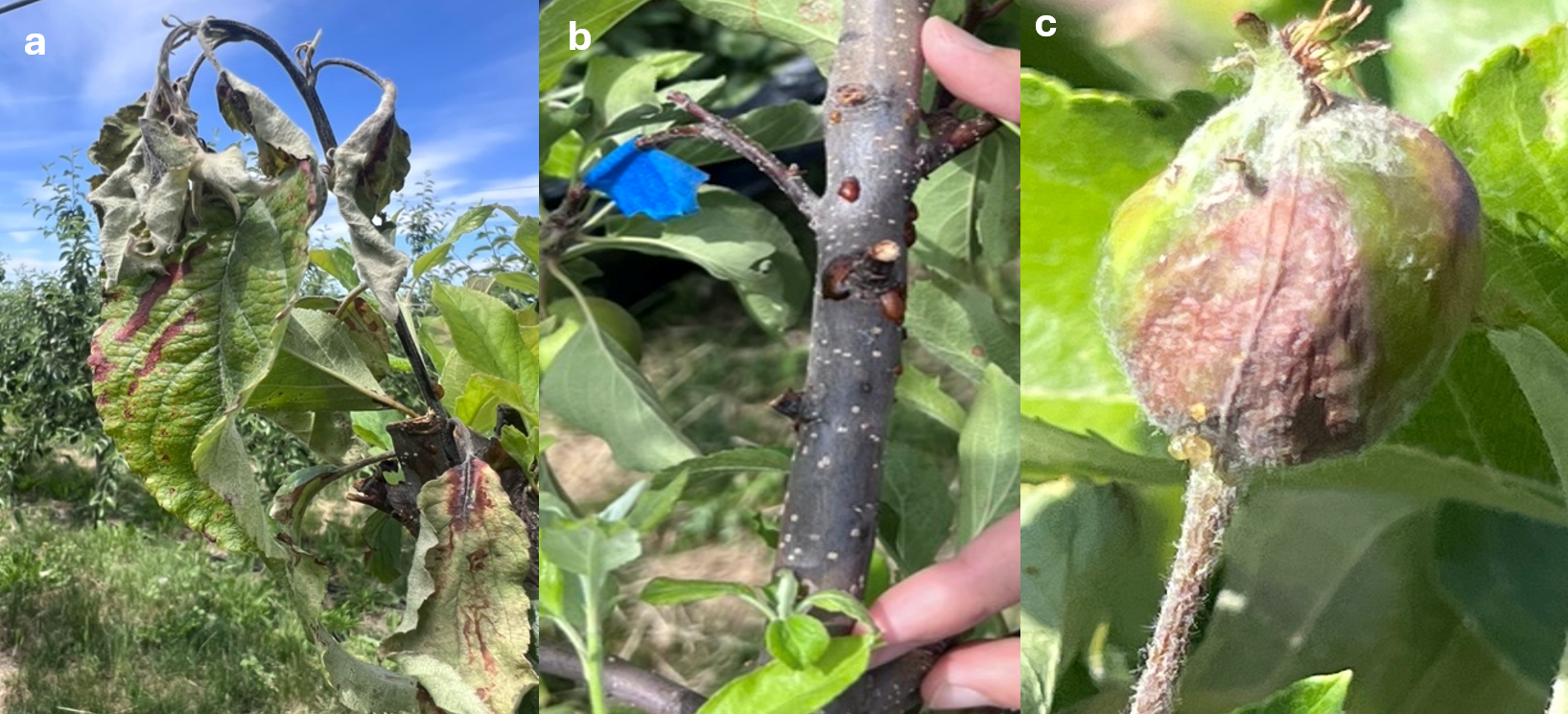
It is normally believed or assumed that the pathogen Erwinia amylovora causing fire blight disease is genetically similar and every orchard has the same pathogen (Fig. 1). A recent study by Washington State University researchers found that this is not the case.
Not all Fire Blight Bacteria are Alike
Fire blight pathogen infects trees almost every year, but one puzzling thing is that disease intensity varies not only from year to year, but also from orchard to orchard. Considering weather conditions are similar and growers apply similar management practices, we still see different levels of disease in different orchards or in different years. It raises an important question: why does fire blight behave differently?
One possible explanation may be due to the differences in bacterium itself. Although the fire blight bacteria look the same on the growth plates or in the trees, different isolates of this pathogen can have different internal genetic machinery, which we call strain types. Understanding these hidden bacterial types might help explain why disease severity changes from place to place and year to year. One way to distinguish these strain types is based on how their genetic material is arranged or flipped.
A Hidden Diversity in the Orchards
During the last three years (2022 to 2024), diseased samples were collected throughout the state and pathogen isolates were collected. Among the collected isolates, four fire blight pathogen types have been identified in Washington State orchards: Ea1189 type, Ea273 type, CFBP1430 type, and Ea401 type. These fire blight pathogen types were present in different locations and in different years; and the mix of fire blight types were also present from orchard to orchard and from season to season (Fig. 2).
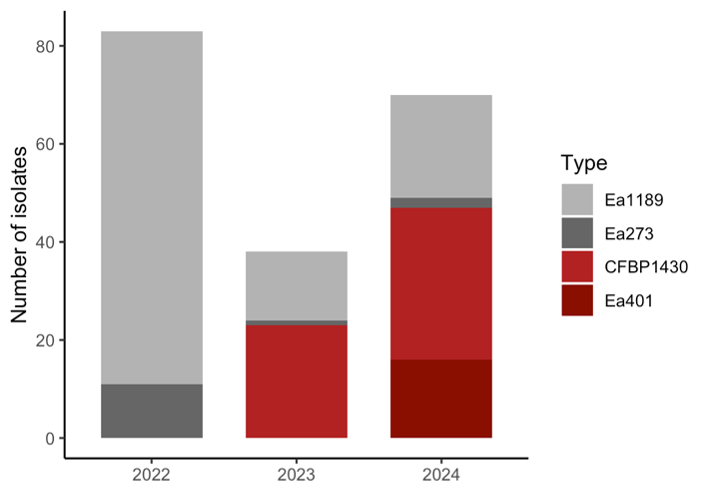
The 2022 result showed that the Ea1189 type was most common across most locations, with only a small percentage of the Ea273 type. During the 2023 and 2024 seasons, the Ea401 and CFBP1430 types were detected and the later become dominant in 2024.
What does this mean to the growers?
Fire blight will always be affected by the environment, the plant host, and orchard management operations. Although at this moment, we still cannot say what and how different types of pathogens affect disease occurrence, we hypothesized that if we understand more about the pathogen’s underlying variations, we might be able to make more accurate predictions, thus better management of the disease. We can also better plan for future outbreaks by understanding not just when fire blight attacks, but also the pathogen type that is responsible for the attack or outbreak.
References
Yang, H-W, Thapa, R., Johnson, K., Dupont, T., Khan, A., and Zhao, Y. F. 2023. Examination of large chromosome inversions in the genome of Erwinia amylovora strains reveals worldwide distribution and north America-specific types. Phytopathology 113:2174-2186.
Contact

Harpreet Kaur
WSU Plant Pathology
harpreet.kaur5@wsu.edu

Frank Zhao
WSU Plant Pathology
youfu.zhao@wsu.edu
Funding
Washington State Department of Agriculture Specialty Crop Block Grant
Fruit Matters articles may only be republished with prior author permission © Washington State University. Reprint articles with permission must include: Originally published by Washington State Tree Fruit Extension Fruit Matters at treefruit.wsu.edu and a link to the original article.