Written by Nipun Thennakoon, Dattatray Bhalekar, Bernardita Sallato, Lav Khot, Washington State University, April 30, 2026
Introduction
Sunburn and heat stress pose a major challenge in Washington apple (Malus domestica Borkh.) production, which can lead to annual yield losses exceeding 10%, and reaching up to 40% under extreme conditions (Racsko and Schrader, 2012; Bolivar-Medina and Kalcsits; 2022, Khot et al., 2024). These losses remain one of the leading causes of fruit damage and reduced packouts across the Pacific Northwest (Schmidt, 2018).
There are three major types of sunburn, namely sunburn necrosis, sunburn browning, and photo-oxidative sunburn (Schrader et al., 2003). Sunburn necrosis, where the thermal death of fruit peels takes place, occurs when the fruit surface temperature (FST) reaches 126 ± 2 °F, while sunburn browning takes place at slightly lower temperatures between 115 °F and 120 °F. Photo-oxidative sunburn can occur at lower FST as it is caused by the photosynthetically active radiation and the sudden exposure of shaded apples to sunlight due to orchard management practices. Overall, FST is considered a reliable indicator of sunburn and heat stress susceptibility (Wang et al., 2020; Schrader et al., 2003).
Accurate FST monitoring is thus vital for making timely management decisions, such as operating overhead evaporative cooling or applying protective coatings. However, the choice of sensing tools is critical for data accuracy and crop loss mitigation. Traditional contact-based sensors, such as thermocouples or internal temperature probes, require physical contact or penetration of the fruit skin. This invasive approach is not only laborious to use and difficult to scale across a commercial orchard, but it also damages the fruit, leading to poor fruit quality and increased risk of disease susceptibility (Li et al., 2014). In contrast, non-contact sensors, including infrared thermometers (IRTs) and radiometric thermal infrared cameras, provide a rapid, non-destructive alternative. While these tools can be sensitive to environmental variables like air temperature and humidity, they allow for faster monitoring without compromising fruit quality. A distinct advantage of thermal imaging over single-point sensors is the ability to capture spatial temperature distributions across the entire fruit surface, identifying the “hot spots” where the risk of damage is highest.
Overall, for better heat stress management decisions, selecting the right tool for measuring FST is critical. Therefore, during the 2025 growing season, we evaluated thermocouples, infrared thermometers, and radiometric thermal infrared cameras for their effectiveness and accuracy in apple FST quantification. Pertinent methods and results are presented in the following sections.
Methods
The study was conducted at the WSU Roza experimental orchard (Prosser, WA) with two apple cultivars, ‘Honeycrisp’ and ‘Cosmic Crisp®’. Measurements were taken during peak heat hours (2:00 p.m. and 4:00 p.m., Pacific Time) over two distinct high-heat days when ambient air temperatures exceeded 95°F. To ensure a representative sample of the orchard blocks, a randomized block design (RBD) was implemented as follows:
- Site Selection: Four random sites were identified within each cultivar block.
- Tree Selection: Within each site, four random trees were selected for measurement.
- Fruit Selection: FST of four fruits were measured per tree (two from the east and two from the west), with distribution across both the upper (> 5.5 ft AGL) and lower canopy (2–5.5 ft AGL).
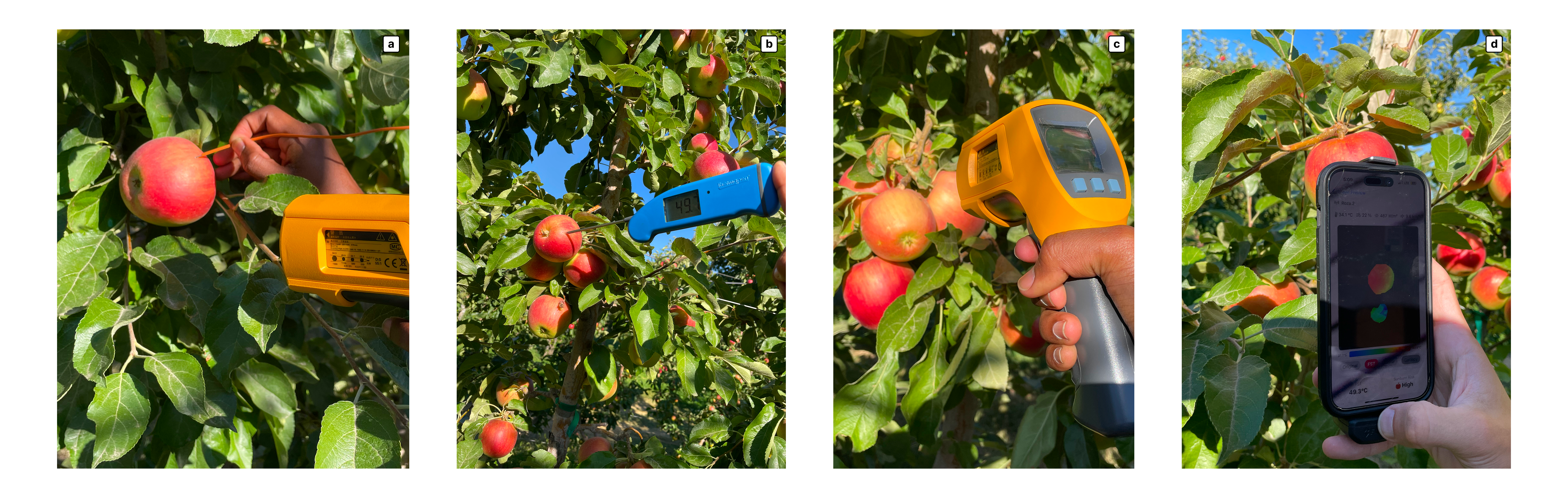
Both surface and internal temperature measurements were taken from each of the selected apples using four different sensors (Figure 1). Internal fruit temperatures were recorded using a K-Type temperature probe (Thermapen One Blue, ThermoWorks, American Fork, UT, USA) inserted approximately 0.25 inches under the fruit skin.
For FST measurements, a combination of contact and non-contact sensing tools was used. A dual-purpose handheld unit (Fluke 568-2, Fluke Corporation, Everett, WA, USA) provided both the infrared and bead thermocouple readings. The bead thermocouple was designated as the reference measurement for surface temperature as it provides a direct measurement of the fruit surface without being influenced by environmental factors such as air temperature or relative humidity. Additionally, a wireless thermal IR camera (FLIR One Edge Pro; Teledyne FLIR LLC, Wilsonville, OR, USA) was used in conjunction with the AWN CropAI smartphone application (AgWeatherNet, Washington State University, WA, USA). Once an image is captured, the algorithm in the app automatically segments the apples from the canopy background and estimates the FST using the hottest 20% of pixels in the segmented image.
To ensure scientific accuracy, all instruments were calibrated across an operating range of 77°F to 140°F. The non-contact sensors (infrared thermometer and thermal IR camera) were calibrated using a blackbody source (Omega BB701; Omega Engineering Inc., Norwalk, CT, USA). The bead thermocouple was calibrated using a dry-well calibrator (Fluke 9103; Fluke Corporation, Everett, WA, USA). The Thermapen temperature probe was factory calibrated as per National Institute of Standards and Technology (NIST) standards.
Results
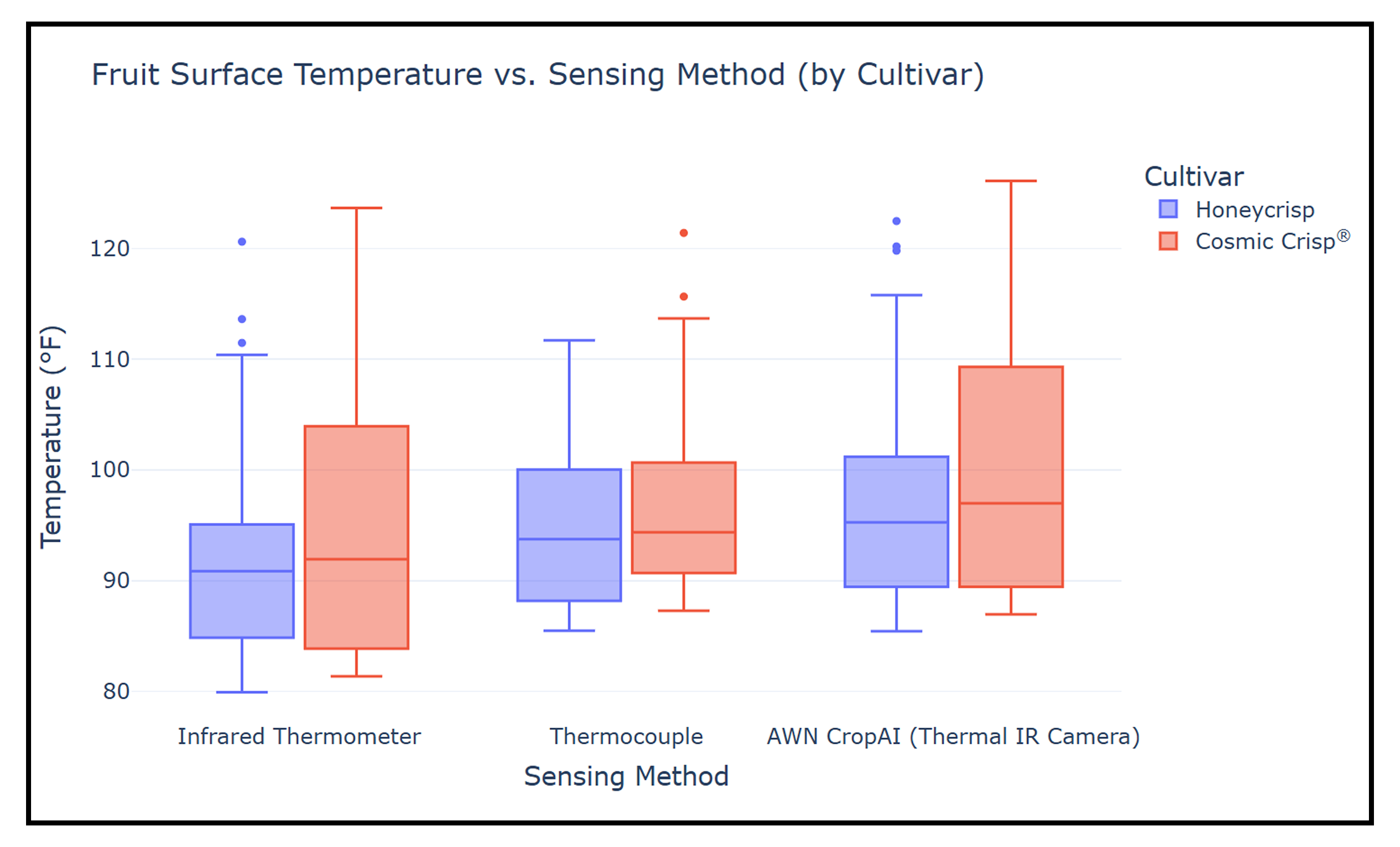
During field trials, the thermal IR camera (connected to AWN CropAI) provided a more protective estimate from a cooling operation standpoint, reporting median temperatures slightly higher (1.5°F for Honeycrisp; 2.6°F for Cosmic Crisp®) than the reference thermocouple. This contrasts with the handheld infrared thermometer (IRT), which recorded slightly lower median temperatures (2.9°F for Honeycrisp; 2.5°F for Cosmic Crisp®) compared to the thermocouple. Both the IRT and the thermal IR camera demonstrated higher variability than the thermocouple, likely due to their ability to capture the spatial temperature gradients across the fruit surface, which in turn increases the variability of FST readings across the blocks. However, all sensing methods recorded peak temperatures exceeding 115°F, the threshold at which sunburn browning becomes imminent. Notably, AWN CropAI recorded peak temperatures exceeding 126°F, the critical point where sunburn necrosis occurs.
The analysis shows that fruit surface temperatures derived from AWN CropAI and the integrated thermal infrared camera, closely tracks thermocouple measurements, with a strong overall relationship (r = 0.92; Figure 3a). The observed slope of 1.30 indicates that the application is more sensitive to temperature increases, largely because it prioritizes the hottest 20% of the fruit surface. Under cooler conditions (below 90°F), when fruit is not under direct sunlight, both tools give nearly the same temperature readings. However, as temperatures rise above 100°F, the readings begin to diverge (Figure 3a). This suggests that during extreme heat events, the temperature across the fruit surface might become increasingly uneven, causing the “hottest 20%” algorithm to diverge further from the single-point thermocouple measurements. This divergence indicates that AWN CropAI offers a more conservative, lower-risk approach by identifying sunburn-prone spots, providing growers with a more protective and representative estimate than traditional contact sensors.
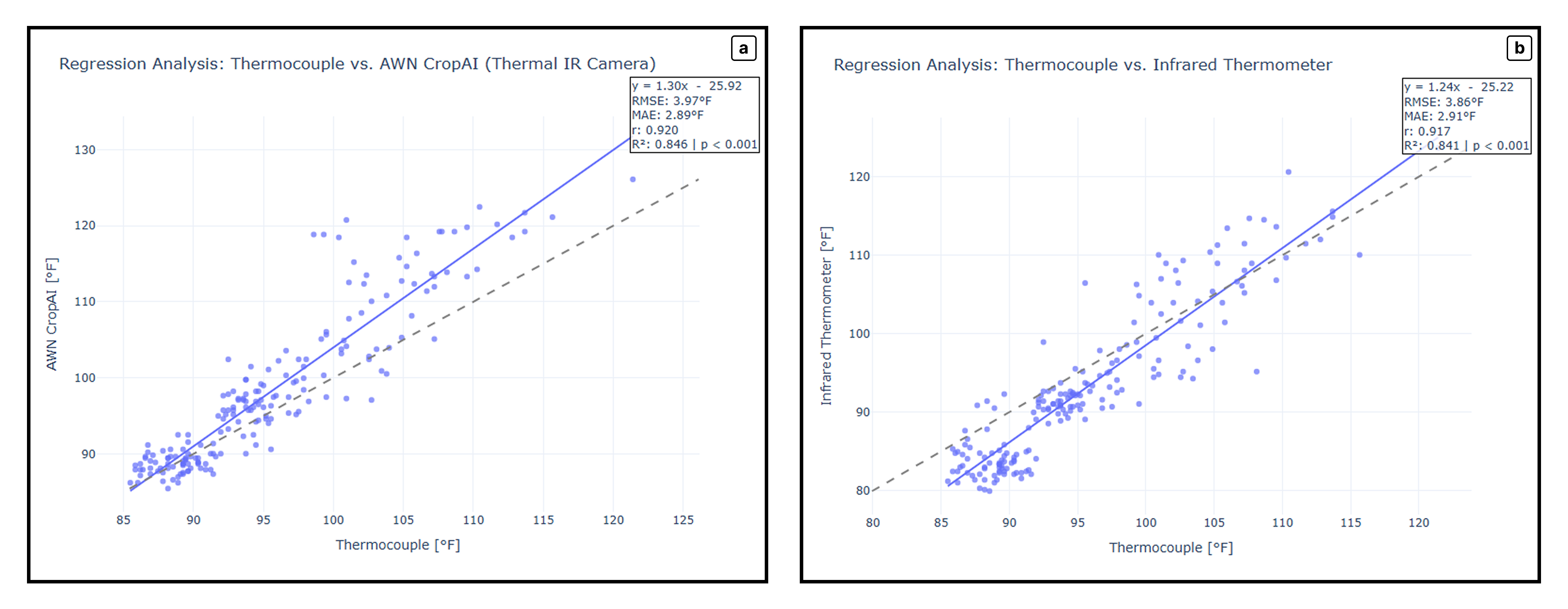
The handheld IRT also tracks fruit temperatures closely when compared with the thermocouple, showing a strong overall relationship (r = 0.917). A slope of 1.24 suggests that the IRT responds well as temperatures increase, likely because it measures a broader fruit surface rather than single-point probe measurements. However, at temperatures below 100°F, the IRT tends to underestimate the FST compared to the thermocouple. This underestimation is likely because the IRT averages hotter sun‑exposed spots with the cooler fruit surface. Also, without precise background segmentation, the sensor’s circular view can inadvertently capture cooler surfaces like the surrounding canopy. Together, these factors “dilute” the measurement, pulling the reported temperature below the reference. As temperatures rise above 105°F, the IRT begins to provide more conservative estimates than the thermocouple, reporting slightly higher values. However, it remains less conservative than the AWN CropAI application. While the IRT responds to the uneven heat distribution caused by extreme weather, its inability to prioritize the “hottest 20%” of pixels results in a less prominent divergence from the reference. For the grower, this means that while the IRT offers more sensitivity than a manual probe at high temperatures, it does not provide the same level of targeted, protective “early warning” as the thermal imager integrated with AWN CropAI application (Figure 3b).
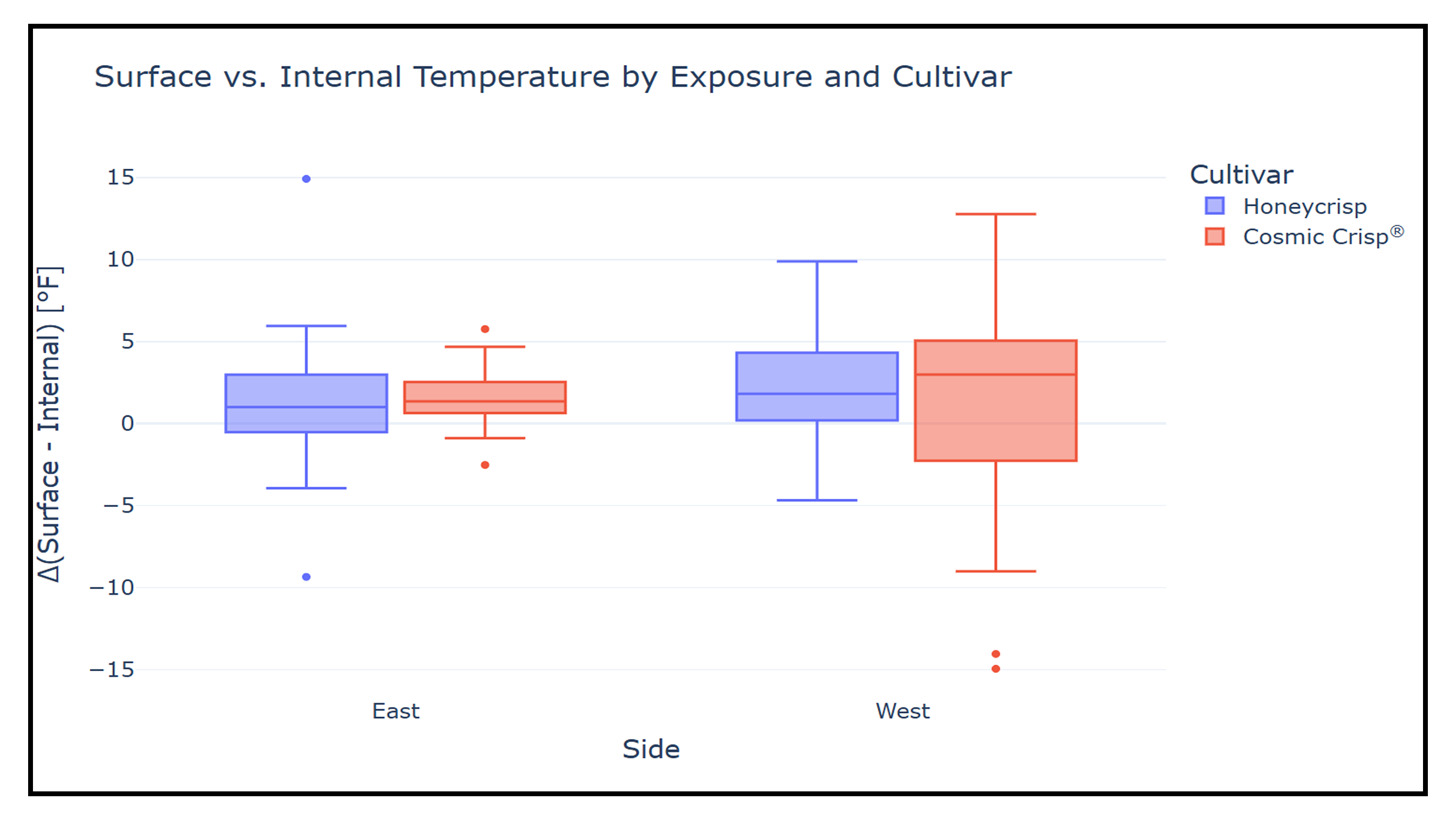
A comparison of internal and surface temperature (Figure 4) reveals that on the shaded east side of the canopy, the fruit surface generally remained 1 to 1.5°F warmer than the internal temperature for both cultivars. However, this relationship becomes significantly more variable on the sun-exposed west side, with the median differences for both cultivars ranging from 1.8 to 2.9°F. Interestingly, both cultivars showed instances where the internal temperature exceeded the surface temperature (indicated by negative values). This was most prominent in ‘Cosmic Crisp®’ on the west side, with differences reaching nearly -15°F in extreme cases. This phenomenon is likely a result of thermal inertia, where the internal fruit mass tends to retain heat and cool more slowly than the skin, which responds more dynamically to air movement and shifts in solar radiation.
Summary
- While non-invasive infrared thermometers are easier to use than contact-type tools, they underestimate the apple fruit surface temperature by up to 3°F due to a larger area of measurement, which often includes cooler backgrounds and non-target elements.
- Thermal-RGB cameras paired with the AWN CropAI app offer improved and more conservative, lower-risk estimates as the app uses an AI-driven segmentation algorithm that isolates the hottest 20% of pixels on fruits, effectively identifying localized “hot spots” at risk of sunburn.
- During peak heat events, the spatial distribution of temperature across the fruit surface becomes more complex and could reduce the quantification precision when using a single-point sensing type probes.
- On average, FST can differ from internal temperature by 1 to 3°F due to thermal inertia; this effect is prominent on the west side of the canopy, particularly for Cosmic Crisp®, where the median differences ranged from 1.8 to 2.9°F.
Contact

Lav Khot
Associate Professor, AgWeatherNet Director
Washington State University
lav.khot@wsu.edu

Nipun Thennakoon
Graduate Student
Washington State University
nipun.thennakoon@wsu.edu
Bernardita Sallato
Tree Fruit Extension Specialist
Washington State University
b.sallato@wsu.edu
Funding and acknowledgements
This research was conducted in WSU PrecisionAg Laboratory with support from NSF/USDA NIFA (Cyber–Physical Systems (Award No: 2021–67021–34336), NIFA project #0745, and Washington Tree Fruit Research Commission. Authors would like to thank Joshua Oliver for help with field data collection.
Additional Reading
Li, L., Peters, T., Zhang, Q., & Zhang, J. (2014). Modeling apple surface temperature dynamics based on weather data. Sensors (Switzerland), 14(11), 20217–20234. https://doi.org/10.3390/s141120217
Racsko, J., & Schrader, L. (2012). Sunburn of apple fruit: Historical background, recent advances and future perspectives. Critical Reviews in Plant Sciences, 31(6), 455–504. https://doi.org/10.1080/07352689.2012.696453
Schrader, L., Zhang, J., & Sun, J. (2003). Environmental stresses that cause sunburn of apple. Acta Horticulturae, 618, 397–405. https://doi.org/10.17660/actahortic.2003.618.47
Wang, B., Ranjan, R., Khot, L., & Peters, R. (2020). Smartphone application‐enabled apple fruit surface temperature monitoring tool for in‐field and real‐time sunburn susceptibility prediction. Sensors (Switzerland), 20(3). https://doi.org/10.3390/s20030608
Bolivar-Medina, J., & Kalcsits, L. (2022). Sunburn in apple and strategies to mitigate it. WSU Tree Fruit.
Khot, L., Amogi, B., Sallato, B., Torres, C., & Peters, T. (2024). Efficient heat stress management for improved apple fruit quality. WSU Tree Fruit.
Schmidt, T. (2018, June 22). Apple sunburn 101. WSU Tree Fruit.
Fruit Matters articles may only be republished with prior author permission © Washington State University. Reprint articles with permission must include: Originally published by Washington State Tree Fruit Extension Fruit Matters at treefruit.wsu.edu and a link to the original article.