Written by Deanna Flynn & Cristina Wilson, Oregon State University, 29 June, 2026
Dormant pruning is a vital orchard task for maintaining crop-load quality and quantity, but it takes years to gain expertise. Given prolonged training periods and agricultural labor shortages, there is an increased interest in automating this decision process.
Beyond mechanical design and computer vision, a major challenge in automated pruning is determining where to make pruning cuts. These decisions depend on complex, plant- and cultivar-specific factors, including tree and branch characteristics, growth history, tree architecture, environmental conditions, and production goals. But how expert pruners map these factors remains largely unknown, as pruning decisions are often based on intuition and experience. Successful automation will require translating these implicit decision-making processes into explicit, algorithmic rules.
To capture these decisions, we conducted over four hours of in-field interviews and observed pruning at sites in Prosser, WA, across:
- Three stakeholder groups: (2) horticulturists, (2) growers, (2) pruners
- Two tree architectures: Upright Fruiting Offshoot (UFO), V-Trellis
- Three tree cultivars: Bing Cherries, Envy Apples, Jazz Apples
Being in the field allowed us to ground participants’ decisions in real-world tree morphology.
From pruning observations, we also created a manually annotated dataset of 661 pruning cuts across the three tree cultivars (124 UFO, Bing Cherries; 229 V-Trellis, Envy Apples; 308 V-Trellis, Jazz Apples). For each identified cut, we labeled the low-level features, such as branch length, branch vector, and number of buds, along with the corresponding cut decisions (e.g., cut placement and angle). Afterward, we grouped cultivar cuts that exhibited the same cut decision into one of three horticultural goals: environmental management, crop-load management, and replacement wood. These goals represent whole-tree- or orchard-level influences that affect cut decisions and were identified through the in-field interviews.
An example decision grouping and horticultural goal for UFO, Bing Cherries can be found in Figure 1. All instances of cuts labeled as longer than 6 inches and with a branch direction of into the interior (of the architecture) or out of the row were mapped to the cut decision to prune at the branch’s base, with an angle parallel to the main branch (see Figure 1 right, red lines). This decision related to the horticultural goal of environmental management, which encompasses pruning decisions that alter the local environment, such as removing or pruning branches to optimize light distribution, increase air circulation, and prevent the spread of fungal or bacterial growth.
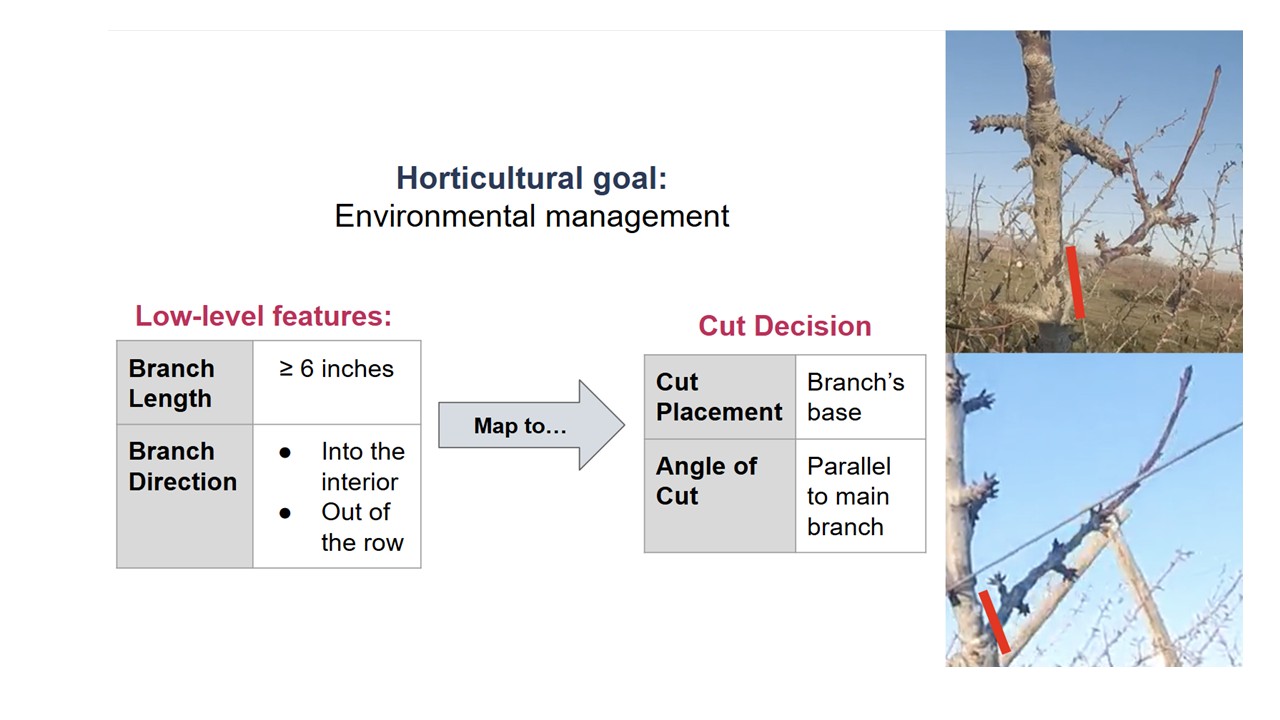
We uncovered 6 additional mappings of horticultural guidelines to cuts, that were validated through interviews with horticulturists. For the full set, see our paper (Flynn et al., 2026). While these decision mappings provide a foundation for autonomous pruning, they are not exhaustive, and future work should expand our decision-capture framework through cultivar-specific studies and more diverse orchard conditions to capture additional decision-making strategies and edge cases.
Contact

Cristina Wilson
Oregon State University
wilsoncr@oregonstate.edu
(541) 737-9169
Funding and acknowledgements
We thank Bernardita Sallato-Carmona and Matthew Whiting for their support of this research and contributions to data capture, as well as the growers and pruners who made this research possible. This material is based on work supported by the AI Research Institutes program, supported by NSF and USDA-NIFA under the AI Institute: Agricultural AI for Transforming Workforce and Decision Support (AgAID) award (no. 2021-67021-35344).
Additional information
Flynn, D., Jain, A., Knight, H., Wilson, C. G., & Grimm, C. (2026). Uncovering Implementable Dormant Pruning Decisions from Three Different Stakeholder Perspectives. HortTechnology, 36(2), 325-332. https://www.doi.org/10.21273/HORTTECH05817-25.
Fruit Matters articles may only be republished with prior author permission © Washington State University. Reprint articles with permission must include: “Originally published by Washington State Tree Fruit Extension Fruit Matters at treefruit.wsu.edu” and a link to the original article.
Use pesticides with care. Apply them only to plants, animals, or sites listed on the labels. When mixing and applying pesticides, follow all label precautions to protect yourself and others around you. It is a violation of the law to disregard label directions. If pesticides are spilled on skin or clothing, remove clothing and wash skin thoroughly. Store pesticides in their original containers and keep them out of the reach of children, pets, and livestock.
YOU ARE REQUIRED BY LAW TO FOLLOW THE LABEL. It is a legal document. Always read the label before using any pesticide. You, the grower, are responsible for safe pesticide use. Trade (brand) names are provided for your reference only. No discrimination is intended, and other pesticides with the same active ingredient may be suitable. No endorsement is implied.