Written by Lexie McDaniel, WSU Tree Fruit Horticulture Extension Educator, September 1, 2026
Two new papers have come out of Dr. Stefano Musacchi’s (WSU Professor and Endowed Chair of Tree Fruit Physiology and Management) lab that explore Green Spot (GS) in WA 38 (Cosmic Crisp®). These studies provide new insight into how GS develops. “Green spot in ‘WA 38’: Growth dynamics, vascular integrity, and architecture, and a hypothetical mechanism” by Carra et el. 2026 proposes a hypothetical mechanism in which the distinctive growth of WA 38 may contribute to vascular dysfunction and altered Ca delivery and distribution among different Ca pools within the fruit. “Changes in skin properties are consequence but not cause of green spot in ‘WA 38’ apples” by Knoche et al. 2026 findings are as the name states.
What is Green Spot (GS) in WA 38?
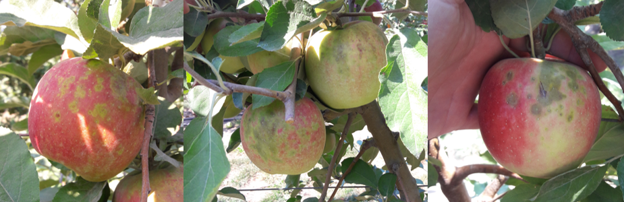
Green spot is a characteristic disorder of WA 38 that has not been reported in its parent cultivars, ‘Enterprise’ and ‘Honeycrisp’. The cause of GS in WA 38 is unknown, and there are currently no management recommendations. GS symptoms (Figure 1) initially appear as green halos or irregular green patches, predominantly toward the stem end of the fruit, and are strongly associated with lenticels. As symptoms progress, affected areas may become sunken and brown, eventually developing cracks and necrotic tissue.
The Main Takeaways
Carra et al. (2026) explore the growth dynamics, vascular integrity and architecture of WA 38. WA 38 fruit exhibited more rapid growth than ‘Honeycrisp’ and ‘Enterprise’ and showed distinctive allometric growth patterns that may contribute to stress and dysfunction of the fruit vascular system. The study found progressive xylem dysfunction and rupture of vascular bundles that proposes WA 38 growth patterns and vascular architecture may contribute to these changes. The authors hypothesize that impaired vascular function could alter Ca delivery and distribution within the fruit, potentially contributing to GS even when total fruit Ca is not consistently associated with symptom development.
Knoche et al. (2026) study the changes in skin properties of GS in WA 38. GS symptoms begin early in fruit development, primarily around lenticels, and their incidence is associated with increased fruit size. Symptomatic areas show localized tissue collapse, increased skin tension, and progressive cracking. The study concluded that the distinctive skin changes associated with GS result from locally restricted tissue expansion and are consequences, rather than the primary cause, of the disorder.
Together, these studies suggest that GS in WA 38 is a growth-related physiological disorder similar to bitter pit in Honeycrisp (Griffith and Einhorn, 2022). Rapid fruit growth appears to contribute to vascular dysfunction and localized calcium imbalances, while the visible skin symptoms develop later as consequences of these underlying internal stresses.
What does this mean?
These two studies provide evidence linking GS in WA 38 with distinctive fruit growth patterns and vascular dysfunction, while also proposing a potential role for altered Ca delivery and distribution within the fruit. The disorder shares some symptoms and possible etiological features with bitter pit; however, total fruit Ca was not consistently associated with GS development in these studies. The visible skin changes associated with GS, which occur predominantly around lenticels, appear to be consequences rather than the primary cause of the disorder.
Taken together, the research suggests that future research to explore effective GS management should focus on strategies that moderate vigor, control excessive fruit growth, and maintain vascular function throughout the season. Although additional research is needed, these studies provide a physiological basis for investigating whether management of fruit growth and tree vigor could influence GS risk.
Potential areas for future management research include:
- Evaluate whether crop load and associated differences in fruit growth influence GS incidence.
- Investigate the relationship between tree vigor, fruit growth, and GS development.
- Determine whether management practices that promote excessive fruit growth increase GS risk.
- Evaluate whether nitrogen and potassium nutrition influence GS through effects on vegetative growth, fruit growth, or Ca relations.
- Investigate whether rootstock-induced differences in vigor and fruit growth affect GS incidence.
- Evaluate irrigation strategies that moderate excessive vegetative growth while maintaining fruit quality.
Contact

Stefano Musacchi
WSU Professor and Endowed Chair of Tree Fruit Physiology and Management
stefano.musacchi@wsu.edu
509-293-8787
Funding and acknowledgements
These papers were funded in part by the Washington Tree Fruit Research Commission and are open access.
Carra B, Serra S, Knoche M, Rudell D, Musacchi S (2026). Green spot in ‘WA 38’: Growth dynamics, vascular integrity and architecture, and a hypothetical mechanism. PLoS One 21(7): e0351512. https://doi.org/10.1371/journal.pone.0351512
Knoche M, Carra B, Serra S, Khanal BP, Hurtado G, Sitzenstock S, Musacchi S (2026). Changes in skin properties are consequence but not cause of green spot in ‘WA 38’ apples. PLoS One 21(8): e0356529. https://doi.org/10.1371/journal.pone.0356529
Additional information
Griffith C, Einhorn TC. (2022). The role of xylem in bitter pit incidence of apple: a review. J Am Pomol Soc. 2022;76(3):125–35. https://doi.org/10.71318/apom.2022.76.3.125.
Sallato B, Whiting M, Munguia J. (2021). Rootstock and Nutrient Imbalance Leads to “Green Spot” Development in WA 38 Apples. HORT SCIENCE 56(12):1542–1548. https://doi.org/10.21273/HORTSCI16213-21
Sheick R, Serra S, Rudell D and Musacchi S (2022). Investigations of Multiple Approaches to Reduce Green Spot Incidence in ‘WA 38’ Apple. Agronomy, 12(11), 2822. https://doi.org/10.3390/agronomy12112822
Sheick R, Serra S, Musacchi S, Rudell D (2023). Metabolic fingerprint of ‘WA 38’ green spot symptoms reveals increased production of epicuticular metabolites by parenchyma. Scientia Horticulturae 321, 112257 (abcdf). https://doi.org/10.1016/j.scienta.2023.112257
WSU Tree Fruit Extension Website – Preliminiary observations on ‘Green Spot’ Symptoms in WA 38
Fruit Matters articles may only be republished with prior author permission © Washington State University. Reprint articles with permission must include: “Originally published by Washington State Tree Fruit Extension Fruit Matters at treefruit.wsu.edu” and a link to the original article.