Written by Tory Schmidt (WTFRC) & Lexie McDaniel (WSU Extension) – 3/18/26
Times are tough for tree fruit growers and we’re all looking for ways to reduce labor costs. Fortunately, we have a new postbloom chemical thinner for apples and pears that has the potential of reducing your hand-thinning bills while also promoting your harvest fruit size and return bloom. Brevis TM SC (metamitron) received its registration with the US EPA and the WSDA in 2025, just in time for chemical thinning season.
As you may recall, the weather across the state was largely cool and sunny during the postbloom thinning window last year. Most postbloom thinners struggle in these low-stress conditions for our pome fruit trees, but metamitron has shown some thinning efficacy even when high temperatures only reach the 60s. Indeed, growers who tried Brevis TM SC last year typically reported that it performed better than other thinning programs and that they plan to use it on more acreage in 2026.
It took a very long time for metamitron to be labeled by the EPA as a chemical thinner of pome fruit, but one upside of this lengthy registration process is that we had ample time to evaluate it on numerous varieties in many locations under variable weather conditions in Washington. We have learned many things about application rates, timings, and tank mixes with metamitron and have been able to evaluate the effects of these variables on trees, fruit set, fruit quality, and return bloom. Here are some key points based on our findings and observations through 15 years of WA Tree Fruit Research Commission (WTFRC) field trials with metamitron that may be helpful as you gain experience with Brevis TM SC:
Mode of action
Metamitron was originally developed as an herbicide for sugar beet production. It triggers a temporary inhibition of Photosystem II in the chloroplasts of plant cells, reducing the production of photosynthates, somewhat like the effect of shade. This can induce temporary stress in fruit trees due to limited availability of carbohydrates, causing the tree to abort some of its developing fruitlets. This effect is amplified if the tree is already prone to stress due to poor soil conditions, winter damage, and especially by hot, humid, cloudy weather around the time of application.
Timing
The Brevis TM SC label requires that applications be made between late petal fall (5-7 mm fruitlet size) and 16-20 mm fruitlet size. Most of our trial work included applications made at petal fall and 8-12 mm fruitlet size, but we did see some efficacy with metamitron as late as 20 mm, a timing at which most other postbloom thinners have little effect under WA conditions. Our experience has been that metamitron is effective at the same traditional timings (petal fall and 10 mm) that standard postbloom thinning programs are typically applied. With all other conditions being equal, apple trees are most susceptible to most postbloom thinning agents around 10-12 mm fruitlet size. At that timing, trees are usually running out of carbohydrate reserves from the previous season, and their leaf area isn’t adequately developed to provide enough new photosynthates. In other words, your best chance of having success with Brevis TM SC or most other postbloom thinners is in warm. cloudy conditions (75-84° F) around 10-12 mm.
Rates
Due to the relatively low stress levels (cool and sunny) our trees enjoy during spring, we need to be more aggressive with our chemical thinning applications in WA to achieve results similar to those from more modest approaches in most other pome fruit producing regions. The Brevis TM SC label allows a range of 16-48 fl oz/acre in WA and requires the use of a standard rate of a non-ionic surfactant (NIS), which has consistently improved efficacy in WTFRC trials. When deciding which rate to use, WA growers might consider starting with 32 fl oz/acre + NIS as a “baseline” and bumping that number up or down depending on other factors including the strength of their bloom thinning program, difficulty of thinning a particular block/variety, and weather conditions. For example, a Cripps Pink (relatively easy to thin) block that received two blossom thinning sprays with a forecast of overcast skies and temperatures in the 80s might do well with a rate of 24 fl oz + NIS. Conversely, a Fuji (relatively difficult to thin) block that received no blossom thinners and facing a forecast of clear sunny skies with temperatures in the 60s should probably consider a more aggressive rate like 40 fl oz/acre + NIS. As with all other chemical thinners, growers and consultants will learn how best to use Brevis TM SC in their own scenarios with firsthand experience.
Phytotoxicity
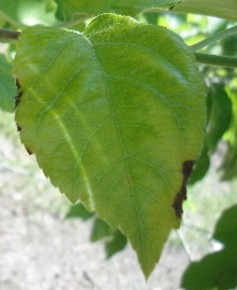
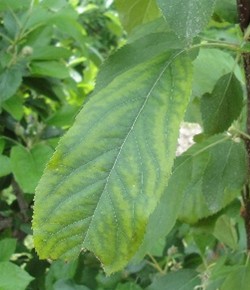
We have seen a wide range of phytotoxic reactions on the leaves of trees treated with metamitron in WTFRC trials. In most cases, there has been no visible damage to leaves at all, but occasionally, we have observed some chlorosis/mottling in between the veins of primary leaves, as well as some marginal leaf burn similar to what we have seen from ATS or lime sulfur (Figure 1). The most severe cases of phytotoxicity have been associated with the use of experimental adjuvants like oils and silicone-based surfactants (not allowed per the product label), applied with metamitron when temperatures were in the 90s. Even in those cases, the trees quickly grew out of that condition, making it difficult to find any evidence of phytotoxicity 2-3 weeks after application. Growers should follow the Brevis™ SC label directions, which require the use of a NIS and applying when temperatures are forecasted to be below 84°F for 1-5 days after application. The label prohibits the use of crop oil concentrate (COC), summer horticultural oil, or tank-mixing with any oil-based formulation. When applied according to these directions, there should be very little risk of significant phytotoxicity. Most importantly, we have never observed any damage to treated fruit, which has been consistently clean in WTFRC trials.
Figure 1. Examples of potential metamitron phytotoxicity from applications at high temperatures (>85°F)
Efficacy
Metamitron has proven itself to be an effective chemical thinner in WTFRC trials; in fact, no other postbloom thinning treatment has been more consistent at delivering significant reductions in fruit set or increases in fruit size and return bloom (Table 1). In our experience, metamitron can still be effective in cool conditions (i.e. temperatures in the 60s), but its performance is certainly enhanced when temperatures are in the 70s and 80s. We have seen some cases of overthinning from applications of high rates made in the high 80s and 90s, so growers should follow the label recommendation of not applying in temperatures above 84°F.
Table 1. Incidence and percentage of thinning trials producing significantly superior results to an untreated control in reducing fruit set, increasing fruit size, and improving return bloom. WTFRC apple chemical postbloom thinning trials 2002-2025. BA=6-benzyladenine, NAA=Naphthaleneacetic acid
| Treatment (active ingredient) | Reduced fruit set | Increased fruit size | Improved return bloom1 |
|---|---|---|---|
| Experiments with significant results / total experiments; (% of experiments with significant results) | |||
| BA | 8 / 33 (24%) | 0 / 35 (0%) | 0 / 34 (0%) |
| Carbaryl + BA | 33 / 92 (36%) | 10 / 90 (11%) | 13 / 87 (15%) |
| Carbaryl + NAA | 30 / 89 (34%) | 23 / 89 (26%) | 19 / 86 (22%) |
| BA + NAA | 20 / 42 (48%) | 9 / 41 (22%) | 9 / 38 (24%) |
| Metamitron | 21 / 40 (53%) | 16 / 38 (42%) | 10 / 36 (28%) |
1 Does not include data from 2025 trials
Pears
Although our database of pear thinning trials isn’t nearly as deep as it is in apple, we have observed statistically significant reductions in fruit set and improvements in fruit size from applications of 24-36 fl oz/acre Brevis TM SC applied at 8-12 mm fruitlet size in recent Bartlett trials. We plan to continue working with metamitron in the coming years to learn more about best use practices for pear thinning.
Other considerations
- Brevis TM SC is safer for honeybees and other pollinators than carbaryl products and is considered “reduced risk” by the EPA.
- Adama has developed a model called BreviSmart to predict a tree’s carbohydrate status based on weather conditions to help guide decisions about appropriate rates and timings of Brevis TM SC applications. Consult your crop advisor for more information.
- Learning how to use new thinning chemistries takes time and experience; consider testing new products on smaller portions of your acreage until you gain more confidence.
References
2024 WTFRC project reports (link opens in a new window)
2021 WTFRC project reports (link opens in a new window)
2017 WTFRC project reports (link opens in a new window)
Contacts
Tory Schmidt
WA Tree Fruit Research Commission
tory@treefruitresearch.com
www.treefruitresearch.org
(509) 669-3903

Lexie McDaniel
WSU Extension – Tree Fruit Horticulture
alexa.mcdaniel@wsu.edu
(509) 303-8512
Fruit Matters articles may only be republished with prior author permission © Washington State University. Reprint articles with permission must include: Originally published by Washington State Tree Fruit Extension Fruit Matters at treefruit.wsu.edu and a link to the original article.
Use pesticides with care. Apply them only to plants, animals, or sites listed on the labels. When mixing and applying pesticides, follow all label precautions to protect yourself and others around you. It is a violation of the law to disregard label directions. If pesticides are spilled on skin or clothing, remove clothing and wash skin thoroughly. Store pesticides in their original containers and keep them out of the reach of children, pets, and livestock.
YOU ARE REQUIRED BY LAW TO FOLLOW THE LABEL. It is a legal document. Always read the label before using any pesticide. You, the grower, are responsible for safe pesticide use. Trade (brand) names are provided for your reference only. No discrimination is intended, and other pesticides with the same active ingredient may be suitable. No endorsement is implied.