Written by Isabel Ortega-Salazar and Carolina A. Torres, Washington State University Department of Horticulture, June 2026
Washington State accounts for approximately 89% of US organic apple production [1]. This industry faces particular challenges due to restrictions on conventional crop protectants for managing fruit quality [2]. Aminoethoxyvinylglycine (AVG), marketed as Retain® (Valent BioSciences), is a plant growth regulator that delays ripening by inhibiting ethylene biosynthesis [3,4]. An organic formulation (Retain®OL) was evaluated across three commercial growing seasons (2019–2021) in ‘Gala’ orchards in Hood River, OR, and Manson, WA [5]. This is the first study to comprehensively assess the organic formulation through a simulated long-cold chain scenario up to 9 months of controlled atmosphere (CA) storage [5].
What Was Tested
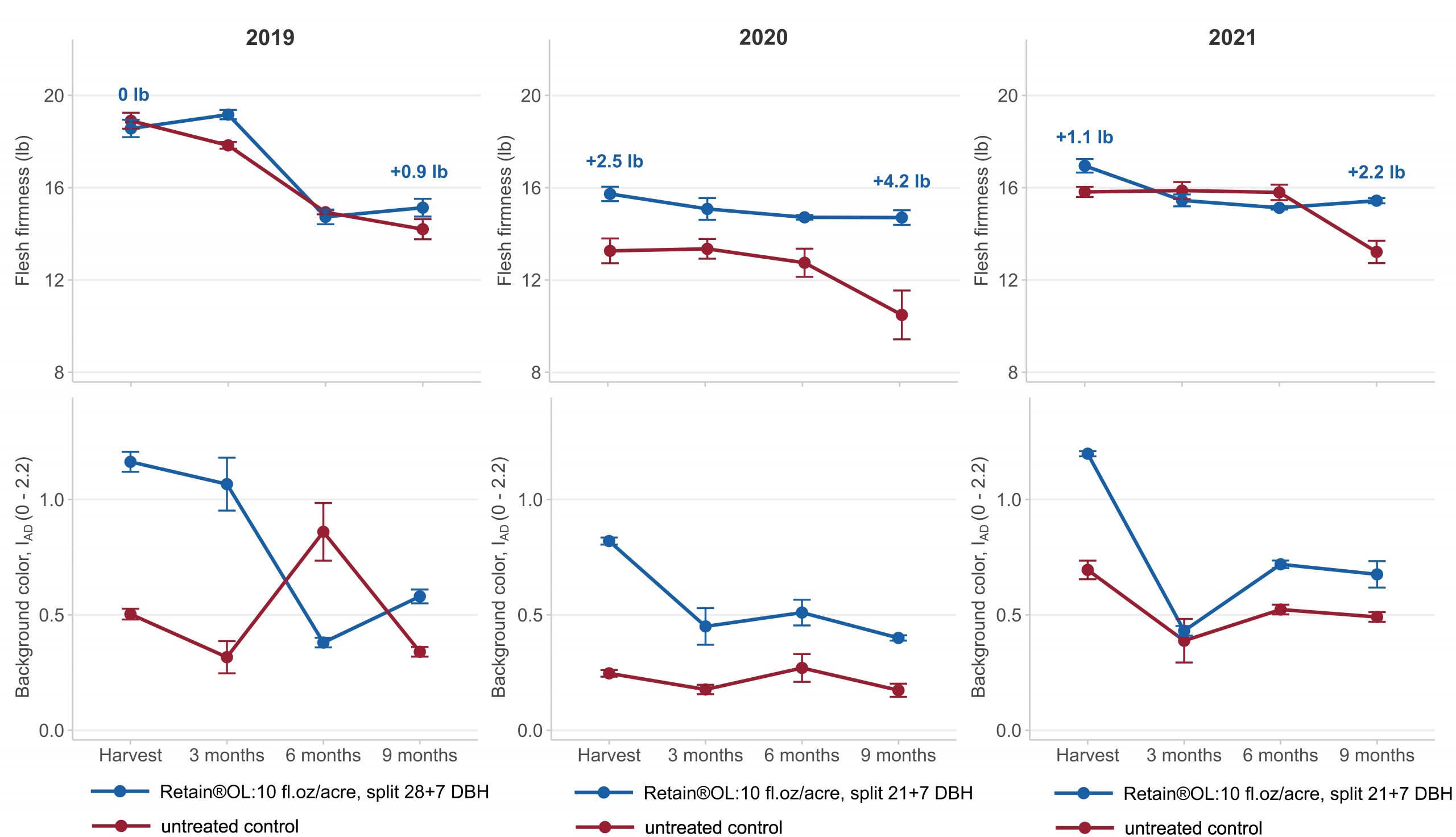
Various application rates and timings were evaluated on organic ‘Gala’ apples against untreated controls over three seasons [5]. A half-dose of 10 fl.oz/acre (1/2 pouch) or a full dose of 20 fl.oz/acre (1 pouch) of Retain®OL were applied singly or as split applications ranging from 21 days before harvest (DBH) down to 1 DBH. Fruit was stored in controlled atmosphere (CA, 32-33 °F, 2 % O₂, 1 % CO₂) after harvest. Figure 1 displays data for the most consistent treatment across seasons: 10 fl.oz /acre, applied 21 and 7 days before harvest.
Key Findings
Flesh firmness and Chlorophyll degradation (IAD)
Overall, Retain®OL-treated fruit maintained higher flesh firmness and retained greener background color (higher IAD, DA meter, Sinteleia, Italy) compared to untreated controls [5]. Furthermore, after 9 months of CA storage in 2020 trials, treated fruit was +4.2 lb firmer than UTC (Figure 1). Improvements in firmness and background color observed in storage highlight the value of Retain®OL for fruit intended for extended cold-storage and marketing periods [5]. As Retain®, the new organic formulation also extends the harvest window while maintaining fruit quality (Figure 1) [5].
Red skin color, starch degradation, and soluble solids
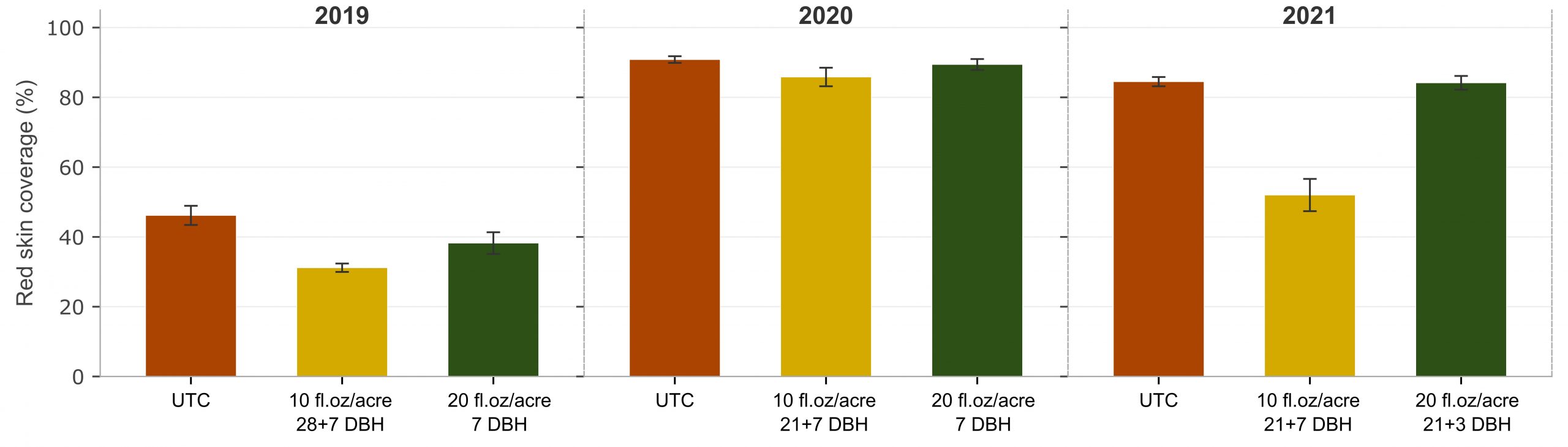
A known side effect of AVG is reduced anthocyanin accumulation, which slows the development of red skin color [6,7]. Red skin color in ‘Gala’ was largely unaffected when Retain®OL was applied as a single full dose close to harvest (20 fl.oz/acre, 7 DBH), while split applications at half-dose showed more variable results across seasons [5] (Figures 2 and 3).
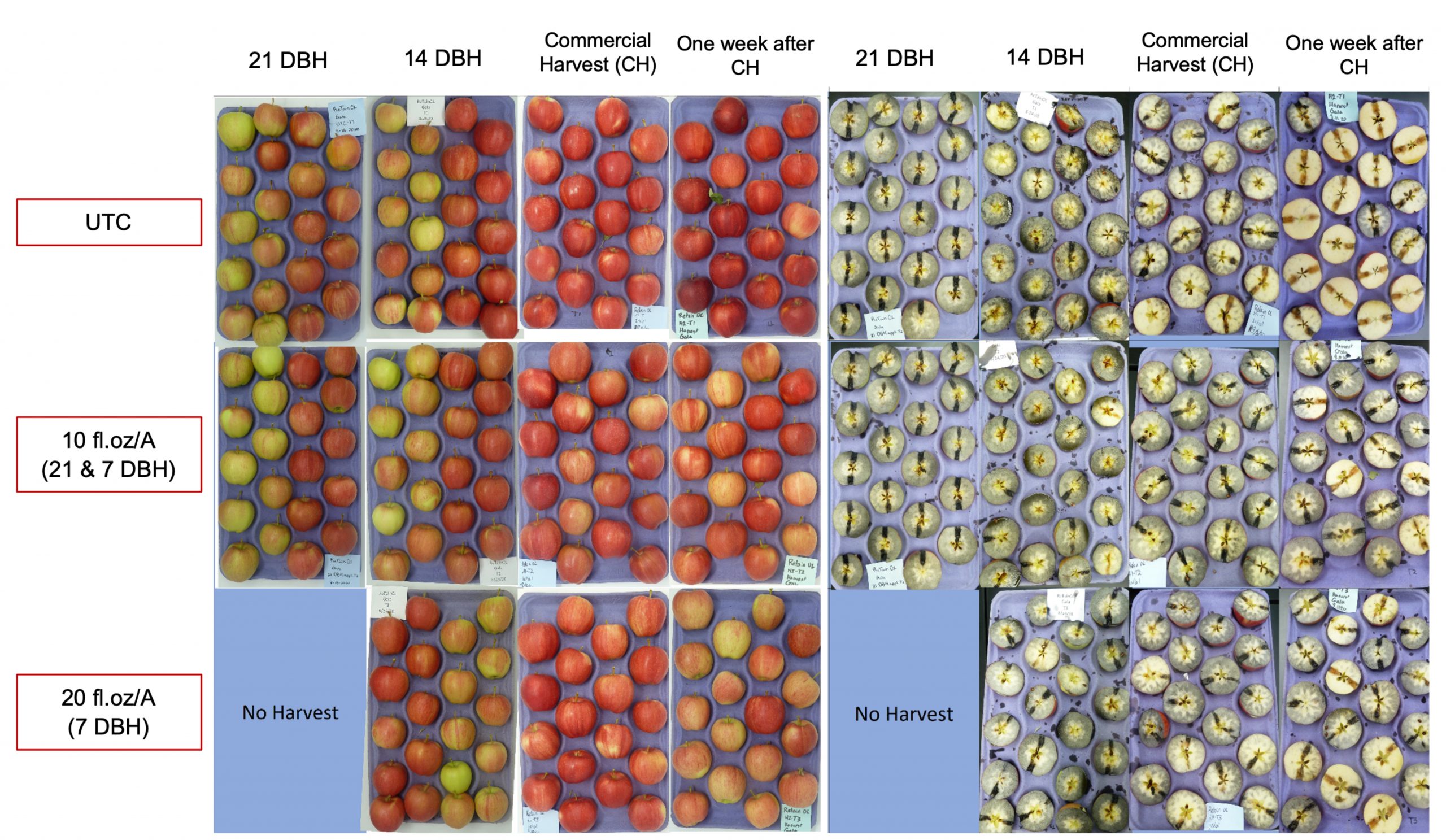
Fruit treated with Retain®OL, particularly with the split application, showed slower starch degradation at harvest and one week later, particularly in seasons where Retain®OL was most effective, like in 2020 (Figure 3). Starch was completely degraded by 3 months of storage, regardless of the treatment [5]. Soluble solids content was largely unaffected by Retain®OL across seasons.
Seasonal variability
Retain®OL effectiveness depends on seasonal conditions and can vary across years [5,8]. Higher temperatures post-application are known to accelerate fruit maturity and reduce Retain®OL effectiveness [8]. Growers should be aware that these conditions can lead to less predictable results from the treatment. In our study, early split applications (21+7 DBH) remained the most reliable strategy across seasons [5].
Conclusion
Results from this multi-season study show that Retain®OL can help organic apple growers delay fruit maturity, maintain firmness, and preserve green background color at harvest and after storage, making it especially valuable for fruit intended for long storage and extended marketing periods. Because responses varied among cultivars, seasons, and application timings, growers should work to optimize application programs for their specific orchard conditions and production goals.
For more details, read the full article here!
Funding and Acknowledgements
This work was partially funded by the USDA-NIFA-OREI project “A Systems-Based Approach to Enhance Quality, Safety and Shelf-life of Organic Tree Fruit in the PNW” (2021-51300-34913), the Washington Tree Fruit Research Commission, and Valent USA. We thank the technical support staff at the Postharvest Systems Laboratory.
References
- Granatstein, D. (2023). Recent trends in certified organic tree fruit in Washington State: 2022. Washington State University Extension.
- Hinman, T., & Ames, G. (2011). Apples: Organic production guide. NCAT, The National Sustainable Agriculture Information Service (ATTRA).
- Depaepe, T., & Van Der Straeten, D. (2017). Ethylene. In B. Thomas, D. J. Murphy, & B. G. Murray (Eds.), Encyclopedia of applied plant sciences (2nd ed., Vol. 1, pp. 403–410). Elsevier Academic Press. https://doi.org/10.1016/B978-0-12-394807-6.00103-9
- Khan, A. S., & Ali, S. (2018). Preharvest sprays affecting shelf life and storage potential of fruits. In M. W. Siddiqui (Ed.), Preharvest modulation of postharvest fruit and vegetable quality (pp. 209–255). Academic Press. https://doi.org/10.1016/B978-0-12-809807-3.00009-3
- Ortega-Salazar, I., & Torres, C. A. (2026). Impact of organic aminoethoxyvinylglycine formulation on pre- and postharvest apple ripening. HortScience, 61(6), 1183–1191. https://doi.org/10.21273/HORTSCI19332-26
- Argenta, L. C., Scolaro, A. M. T., do Amarante, C. V. T., Vieira, M. J., & Werner, S. S. (2018). Preharvest treatment of ‘Gala’ apples with 1-MCP and AVG: Effects on fruit maturation on the tree. Acta Horticulturae, 1194, 113–120. https://doi.org/10.17660/ActaHortic.2018.1194.18
- Doerflinger, F. C., Nock, J. F., Miller, W. B., & Watkins, C. B. (2019). Preharvest aminoethoxyvinylglycine (AVG) and 1-methylcyclopropene (1-MCP) effects on ethylene and starch concentrations of ‘Empire’ and ‘McIntosh’ apples. Scientia Horticulturae, 244, 134–140. https://doi.org/10.1016/j.scienta.2018.09.031
- Stover, E. W., & Greene, D. W. (2005). Environmental effects on the performance of foliar-applied plant growth regulators: A review focusing on tree fruits. HortTechnology, 15(2), 214–221. https://doi.org/10.21273/HORTTECH.15.2.0214
Contact

Carolina Torres
Endowed Chair
Postharvest Systems, Horticulture
WSU Tree Fruit Research & Extension Center
509-293-8808
ctorres@wsu.edu
Regulatory Note: The product discussed in this article was evaluated as part of research conducted prior to registration and is not currently registered for commercial use. Research results are provided for informational purposes only and should not be interpreted as a recommendation for use.
Fruit Matters articles may only be republished with prior author permission © Washington State University. Reprint articles with permission must include: “Originally published by Washington State Tree Fruit Extension Fruit Matters at treefruit.wsu.edu” and a link to the original article.
Use pesticides with care. Apply them only to plants, animals, or sites listed on the labels. When mixing and applying pesticides, follow all label precautions to protect yourself and others around you. It is a violation of the law to disregard label directions. If pesticides are spilled on skin or clothing, remove clothing and wash skin thoroughly. Store pesticides in their original containers and keep them out of the reach of children, pets, and livestock.
YOU ARE REQUIRED BY LAW TO FOLLOW THE LABEL. It is a legal document. Always read the label before using any pesticide. You, the grower, are responsible for safe pesticide use. Trade (brand) names are provided for your reference only. No discrimination is intended, and other pesticides with the same active ingredient may be suitable. No endorsement is implied.