Written by Bernardita Sallato, Washington State University, May 8, 2026
As orchards transition from bloom into early fruit development and rapid shoot growth, tree fruits enter a period of high nutrient demand and increasing root uptake efficiency. Nutrient management during this stage should target rapid growth demands, adjust to the current season’s crop load, address micronutrient deficiencies, and protect fruit quality.
In apples and pears, which have a longer growing season compared to sweet cherries, the post-bloom window is one of the most critical periods for determining fruit size, return bloom, and overall orchard performance. In sweet cherries this period is relevant to correct deficiencies if present.
Drawing from Washington State University Tree Fruit Extension resources; including the Tree Fruit Nutrition, the Sweet Cherry nutrient management guide and the WSU Crop Protection Nutrient guide, this article highlights key priorities for growers post-bloom nutrient management.
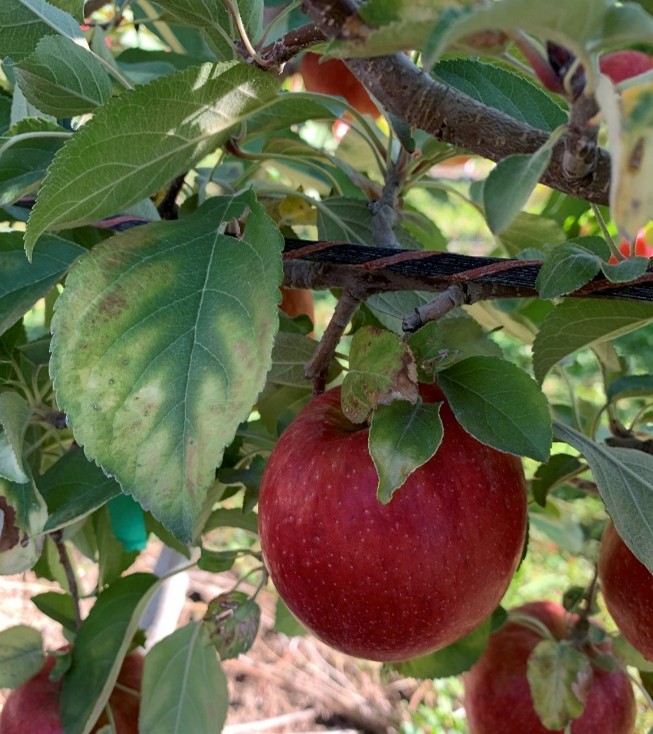
Rapid increase in nitrogen demand after bloom
Following bloom, deciduous trees enter a phase of intensive growth driven by developing fruit, expanding shoots, and active root growth in apples (Nielsen et al., 2017, Sallato, 2021), pears and cherries (Artacho and Bonomelli, 2016). Roughly, during the first 4-5 weeks after full bloom (AFB), nutrient requirements is supported by the reserves accumulated the previous season. Once the reserves are exhausted, and roots become more active, trees will start taking up nutrients from the soil solution.
This is the time were fertilizer programs should be adjusted to support actual crop load, tree vigor, soil nutrient supply and contributions from irrigation water and organic matter.
The guiding principle remains:
Nutrient rate = Tree demand – Supply
Plant demand can be estimated using the table below. Select the lower value within each range if your blocks have a history of physiological disorders: bitter pit or green spot, soft fruit, or excessive vigor.
Table 2. Nutrient extraction in pounds of element per ton of fruit harvested.
| Crop | Nitrogen (N) Lbs/ Ton | Phosphorous (P) Lbs/ Ton | Potassium (K) Lbs/ Ton | Calcium (Ca) Lbs/ Ton | Magnesium (Mg) Lbs/ Ton |
|---|---|---|---|---|---|
| Apple | 0.9 – 2.1 | 0.2 – 0.4 | 2.0 – 3.9 | 0.1 – 0.3 | 0.1 – 0.2 |
| Green apple | 3.1 | 0.4 | 3.4 | – | – |
| Apricot | 8.3 – 11 | 1.3 | 6.6 | – | – |
| Cherry | 1.9 – 4.9 | 0.5 – 0.9 | 2.9 – 6.3 | 0.3 – 0.4 | 0.2 – 0.4 |
| Peach | 4.5 – 12 | 1.2 | 8.1 | – | – |
| Pear | 1.3 – 2.7 | 0.6 | 3.0 | – | – |
Nutrient extraction by crop yield can help estimate nutrient maintenance rate. Multiply your yield in tons per acre, by the value provided in the table. The result corresponds to the amount extracted by the crop per acre. This value, minus the supply, provides an estimate of the rate in pounds needed.
References: Cheng and Raba, 2009, Weinbaum et al. 1992, Sallato et al (2022) and Sallato et al (2024)
Overapplication of nitrogen during this stage can promote excessive vegetative growth, reduce fruit quality (color and firmness), increase susceptibility to physiological disorders, and delay maturity. In sweet cherry, avoid nitrogen application within a month from harvest.
Conversely, insufficient supply—especially in apples and pears—may limit fruit size, reduce canopy development, and contribute to alternate bearing.
Crop considerations
This is an appropriate time to adjust nutrient programs based on final crop load estimates. If orchards were affected by frost or poor set, nutrient rates—particularly nitrogen—should be reduced accordingly to avoid excessive vegetative growth.
Micronutrient management
The amount required of micronutrients; boron (B), zinc (Zn), copper (Cu), manganese (Mn) are small, but they are still essential for growth and development (Peryea, 2019). In Washingtons alkaline soils, micronutrients, particularly Fe, can become unavailable, even when present in high levels in the soil, leading to plant deficiencies. These deficiencies are easy to diagnose in younger leaves or new growth (Figure 2).
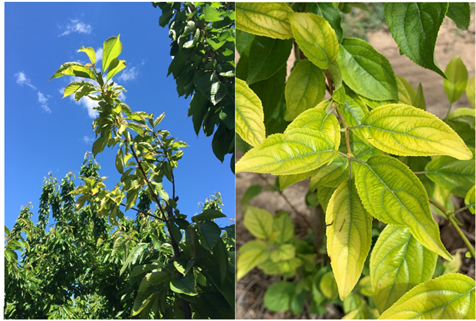
Under confirmed deficiency; clear symptoms or low levels in leaf analysis (see leaf tissue analysis), micronutrient should be applied during active growth. For rates and crop specific recommendations visit WSU Crop Protection Guide/ Nutrients.
Integrating irrigation and nutrient delivery
Efficient nutrient uptake post-bloom requires adequate soil moisture and irrigation practices. In many Central Washington orchards, coarse-textured soils combined with long irrigation sets can increase the risk of nutrient leaching, particularly nitrogen and boron.
Best practices include:
- Synchronize fertigation with irrigation scheduling
- Adjust application rates based on soil type and water movement
- Account for nutrients delivered through irrigation and overhead water
- Precision tools can help manage and monitor water use efficiency
For more information regarding precision tools for water use efficiency, visit WSU smart orchard or Irrigation Management page .
Select a source of nitrogen will depend mostly on your application strategy; liquid or solid, soil texture and soil pH, and the need for additional nutrients. For more information watch the video on Optimizing Nutrient Management for Fruit Quality or contact your extension specialist for guidance.
Calcium (Ca) management and fruit quality protection
Calcium plays a central role in fruit quality, particularly in apples and pears, where deficiencies are linked to disorders such as bitter pit and cork spot. Effective fruit Ca uptake will take place during early stages of cell division, between 4-6 weeks after bloom. This period coincides with active root growth, main pathway for Ca uptake( For more information watch this video on bitter pit in apples)
During this period, monitor Ca levels in the soil and keep a balance with potassium and magnesium levels based on this soil critical values. At the same time, regulate vigor and avoid excessive water and nitrogen to reduce the risk for Ca related disorders.
Summary
Management decisions made during the post-bloom period have long-lasting effects on fruit quality and return bloom. For apple, cherry, and pear growers, priorities at this stage include:
- Aligning nitrogen and overall fertilization with crop demand
- Monitoring and spraying low-mobile micronutrients with small but frequent rates
- Integrating irrigation and nutrient delivery to minimize losses
- Establishing monitoring systems to guide in-season adjustments
Additional information
Fruit Tree Nutrition Guide (WSU)
Sweet Cherry Nutrient Management (WSU)
Crop Protection Guide. 2024. Washington State University.
Contact

Bernardita Sallato
Tree Fruit Extension
Washington State University
b.sallato@wsu.edu
Reference
Artacho P and Bonomelli C. 2016. Changes in fine-root production, phenology and spatial distribution in response to N application in irrigated sweet cherry trees. Tree Physiol 36(5):601-17. doi: 10.1093/treephys/tpw002.
Neilsen, G.H., D. Neilsen, and T.A. Forge. 2017. Advances in Soil and Nutrient Management in Apple Cultivation. In Achieving Sustainable Cultivation of Apples, K. Evans (ed.) 239–278. Burleigh Dodds Science Publ., Cambridge, U.K.
Neilsen, D., and G.H. Neilsen. 2002. Efficient Use of Nitrogen and Water in High-Density Apple Orchards. HortTechnology 12(1):19–25.
Fruit Matters articles may only be republished with prior author permission © Washington State University. Reprint articles with permission must include: “Originally published by Washington State Tree Fruit Extension Fruit Matters at treefruit.wsu.edu” and a link to the original article.