Written by Tianna DuPont, WSU Extension; Rob Curtiss, WSU Entomology, February 7, 2025. Updated March 4, 2026
For growers intending to use selective IPM programs (limiting broad spectrum sprays) for pears this season here are a few considerations for success.
If folks are going to try an IPM program, what tools do you suggest to help them reduce the risk?
Panelists at Tree Fruit Days said:
- Have a honeydew washing system.
- Consider an early spray before the predators come out to start out low.
- Use mating disruption and first gen codling moth sprays that you might not be used to.
- Don’t forget good practices like pruning and making sure your sprayer is working early.
Importance of Early Season Particle Films
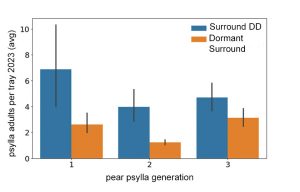
Particle films and oil are an important foundation for a successful pear IPM program. Remember particle films are doing three things: confusing the psylla so it is more difficult to find the orchard, deterring egg lay, and lining up egg lay so the generation is more uniform. Particle films can reduce pear psylla adult colonization and egg lay by 80–100%, which reduces pear psylla pressure for the first generation (Hull et al. 2008; Nottingham et al. 2020; Nottingham and Beers 2022). Particle film applications are generally used in combination with oil. Before use of kaolin became standard in the Wenatchee Valley, dormant oil was used as an oviposition deterrent, and it is also very effective for this purpose.
- Applying particle films starting as early as possible is important (see Figure 1).
- Multiple pre-bloom applications are important to cover green tissue as emerges and successfully reduce psylla in the 2 generations (Figure 2).
Particle film timings include:
- A particle film application (Surround CF/WP or Celite 610 at 50 lb/acre) as early as it is safe to drive a sprayer through the orchard. This spray prevents pear psylla from colonizing the orchard.
- Pear psylla adults will begin laying eggs on soft green tissues as soon as they emerge from flower buds. A particle film application (Surround CF or Celite 610 at 50 lb/acre) applied just before budburst renews particle film residues, repels pear psylla adults, and prevents egg lay. If budburst is the first spray a grower can make, a second particle film spray at popcorn may be necessary.
- At 900 PDD (Surround CF, Celite 610 at 50 lb/acre) to deter the emerging summerform adults from landing on trees and laying eggs.

Prebloom – Broad Spectrum Sprays
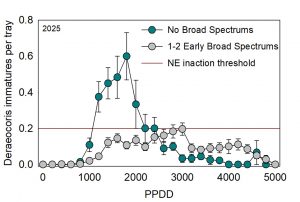
Two factors are important to consider when determining if and when to include an early season broad spectrum: what timings have highest efficacy, and which will limit impacts on natural enemies. Most natural enemies start to become present in the orchards around bloom time (Figure 4), however Deraeocoris overwinter as adults and will be impacted by early sprays. Nottingham also found that products aimed at adults were more effective when applied at delayed dormant than at popcorn.

Incorporate Codling Moth Management
In some blocks where orchardists are avoiding broad spectrum materials in their pear psylla program, codling moth has become a problem. If you are new to a selective program, don’t forget to include compatible codling moth management.
- Mating Disruption
- First-generation sprays at 375 and 525 DD (or 225 & 425 DD).
- Second generation + 1000 DD
Oil, pyriproxyfen (Esteem/ Reemit), methoxyfenozide (Intrepid 2F), chlorantraniliprole (Altacor), diflubenzuron (Dimilin 2L), GS-omega/kappa-Hxtx-Hv1a (Spear-Lep), and granulovirus (Cyd-X HP) are options with reduced risk to natural enemies of pear psylla (Dunley et al., 2002; Van Steenwyk and Nomoto, 2002; Van Steenwyk et al., 2003; Van Steenwyk et al., 2004; Van Steenwyk and Weiss, 2015).
Start IPM in Blocks with Honeydew Washing
While selective IPM programs have had similar success as conventional programs (link opens in a new tab), natural enemies do not always reach high enough populations in early June to control second generation nymphs. The ability to apply targeted early season washes with a honeydew washing system provides insurance while natural enemy populations build. Honeydew washing systems should have sufficient volume, 70 to 80 gallons per minute to wash the honeydew off of the fruit, rather than just to the bottom of the fruit. Uniform coverage is also important, for example a 30 by 40 foot spacing. See Honeydew Washing case studies (link opens in a new tab) for more details.
Additional information
Pear Psylla Integrated Pest Management
Pear Psylla Phenology Model
Decision Aid System
Managing Mites in Pears
Codling Moth Mating Disruption
Contacts
Tianna DuPont
WSU Extension
tianna.dupont@wsu.edu
(509) 713-5346
Rob Curtiss
WSU Entomology
rcurtiss@wsu.edu
(509) 293-8775
Fruit Matters articles may only be republished with prior author permission © Washington State University. Reprint articles with permission must include: Originally published by Washington State Tree Fruit Extension Fruit Matters at treefruit.wsu.edu and a link to the original article.