Written by Mengqian Hang, Edmund Larbi Afari, Manoella Mendoza, and Mei-Jun Zhu, School of Food Science, Washington State University, December 19, 2025
Introduction
Listeria monocytogenes is a significant foodborne pathogen that can cause listeriosis, a serious illness with a high mortality rate in susceptible populations, including pregnant individuals, newborns, the elderly, and immunocompromised persons [1]. This bacterium is widely distributed in natural and food production environments and has been linked to multiple outbreaks associated with fresh produce, emphasizing the need for proactive measures to minimize post-harvest contamination risks.
The Pacific Northwest region leads pear production in the United States, producing 413,200 tons of fresh pears in 2023 [2], with Washington State topping the pear production in the region. While whole pears have not been linked to documented listeriosis outbreak, recent outbreaks and recalls involving other tree fruits due to potential L. monocytogenes contamination have highlighted the importance of understanding how this pathogen behaves on pears during storage. Insights into Listeria survival under different postharvest conditions can help guide practical control strategies.
How the study was conducted
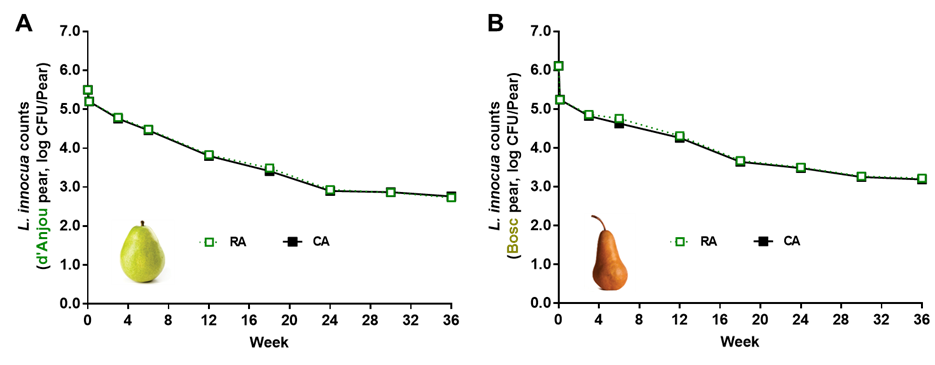
Unwaxed Bartlett, d’Anjou, and Bosc pears were inoculated with Listeria and stored at various temperatures or under refrigerated air (RA) and controlled atmosphere (CA) conditions for up to 36 weeks.
Key findings
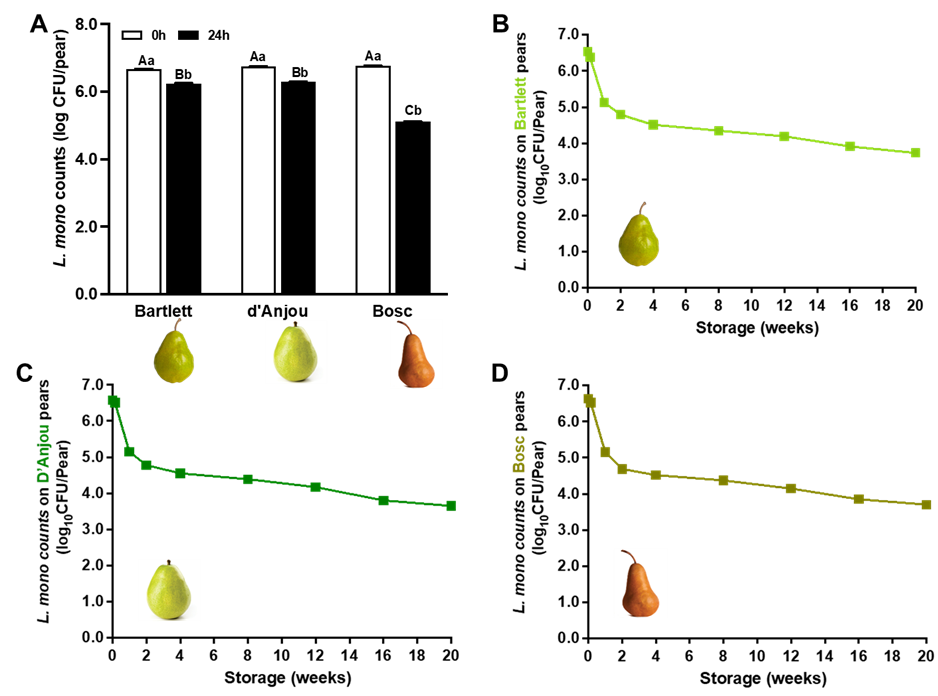
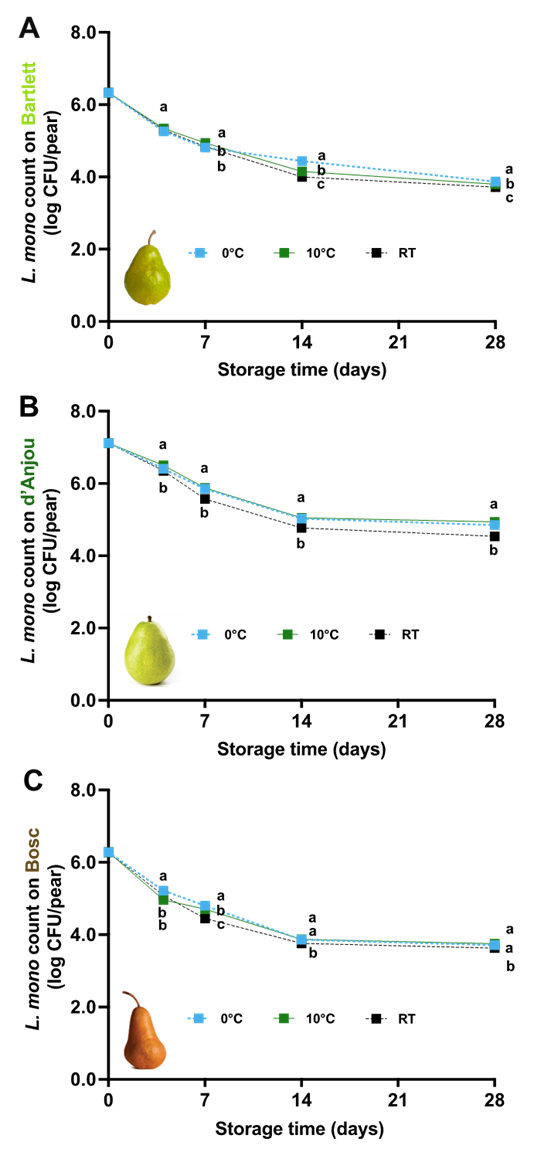
Listeria declines over time but persists: Across all pear varieties and storage conditions, Listeria populations decreased gradually, resulting in a 2.5–2.9 log reduction by the end of 36 weeks of commercial storage. Despite this decline, the pathogen remained detectable throughout the storage period (Figures 1–3).
Variety influences initial establishment: During the first 24 hours at ambient temperature, Listeria levels declined more sharply on Bosc pears (rough surface), ~1.6 log CFU/pear, compared to ~0.5 log on Bartlett and d’Anjou pears (smooth surfaces) (Figure 1A). This suggests that pear surface microstructure affects the initial attachment and establishment of Listeria.
Storage conditions have limited impact: Commercial RA and CA storage had minimal effect on Listeria survival on pears. Room temperature storage led to slightly faster reductions, but overall survival patterns were similar across storage conditions for all pear varieties (Figures 2–3).
Practical implications for the pear industry
These findings confirm that pears do not support L. monocytogenes growth during storage, although long-term survival remains a concern. To help minimize Listeria risk, the industry may take steps:
- Prevent contamination throughout production and handling processes.
- Maintain strict sanitation in packinghouses and storage facilities.
- Implement holistic control strategies that combine multiple interventions to minimize pathogen persistence.
Contact
Mei-Jun Zhu
Washington State University, School of Food Science
meijun.zhu@wsu.edu
509-335-4016
Funding and acknowledgements
This project was supported by the Center for Produce Safety. We gratefully acknowledge the Washington Tree Fruit industry for their valuable input and support, as well as the contributions and efforts of the Washington State University Food Microbiology Research Team.
References
- Su, Y., A. Liu, and M.J. Zhu, Mapping the landscape of listeriosis outbreaks (1998–2023): Trends, challenges, and regulatory responses in the United States. Trends Food Sci Technol, 2024. 15: p. 104750.
- NHC, Pacific Northwest Pears – pear fact sheet. https://nwhort.org/industry-facts/pear-fact-sheet/. 2025.
- Hang, M., et al., Population dynamics of Listeria monocytogenes and Yeast and Mold levels on different pear varieties during simulated storage. Foods, 2025. 14(10).
Fruit Matters articles may only be republished with prior author permission © Washington State University. Reprint articles with permission must include: Originally published by Washington State Tree Fruit Extension Fruit Matters at treefruit.wsu.edu and a link to the original article.