- This event has passed.
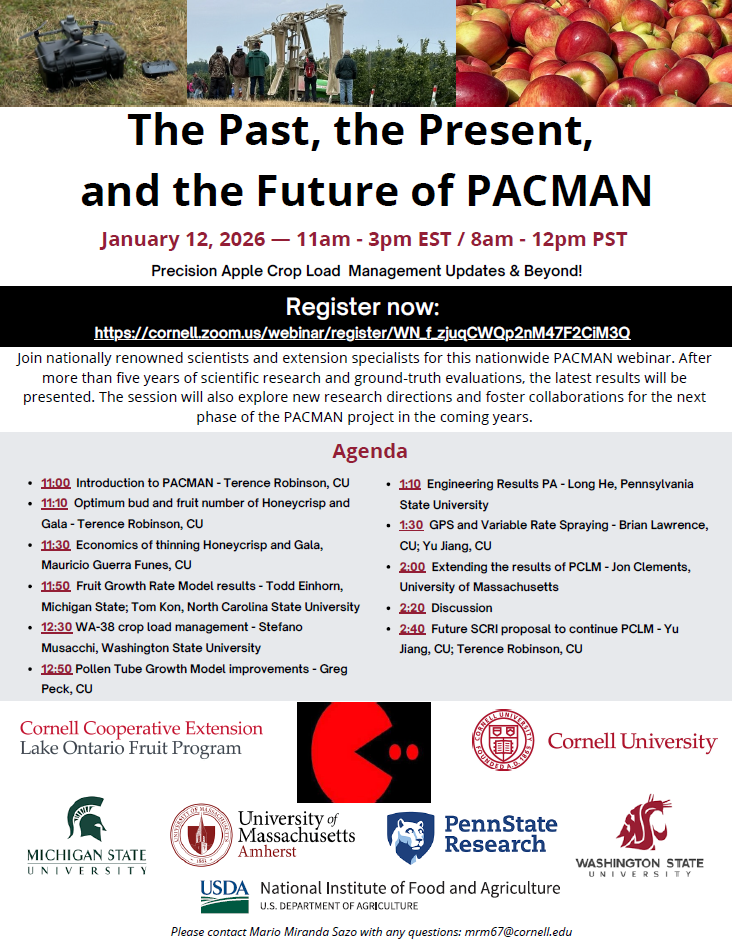
Webinar: The Past, The Present, and The Future of PACMAN: Key Advances in Precision Crop Load Management
January 12 @ 8:00 am - 12:00 pm
What Has PACMAN Delivered for U.S. apple growers?
Key Advances in Precision Crop Load Management.
Plan to Attend the Coming Nationwide Zoom Webinar:
‘The Past, The Present, and The Future of PACMAN’
Click Here to Access the Registration Link
Monday Jan. 12, 2026
08:00am-12pm Pacific Standard Time
09:00am-1pm Mountain Standard Time
10:00am-2pm Central Standard Time
11:00am-3pm Eastern Standard Time
All growers are warmly invited to participate in a nationwide PACMAN (Precision Apple Crop Load Management) webinar featuring nationally renowned scientists. After more than five years of scientific research and ground-truth evaluations, the latest PACMAN results will be presented.
The webinar will also highlight new research directions and provide opportunities for collaboration as we plan the next phase of the PACMAN project in the coming years.
Don’t miss this chance to learn about cutting-edge technologies and strategies that can help improve crop load management and orchard efficiency.
Agenda
11:00-11:10am: Introduction to SCRI-PACMAN project – Terence Robinson, CU
11:10-11:30am: Optimum bud and fruit number of HC and Gala – Terence Robinson, CU
11:30-11:50am: Economics of thinning HC and Gala – Mauricio Guerra, CU
11:50-12:30pm: Fruit Growth Rate Model results – Todd Einhorn, MSU; Tom Kon, NCS
12:30-12:50pm: WA-38 crop load management – Stefano Musacchi, WSU
12:50-1:10pm: Pollen Tube Growth Model improvements – Greg Peck, CU
1:10-1:30pm: Engineering Results – Long He, PSU
1:30-2:00pm: GPS and Variable Rate Spraying – Brian Lawrence, Yu Jiang, CU
2:00-2:20pm: Extending the results of PCLM – Jon Clements, UMass
2:20-2:40pm: Discussion
2:40-3:00pm: Future SCRI proposal to continue PCLM – Yu Jiang and Terence Robinson, CU
What Has PACMAN Delivered for U.S. apple growers?: Over the past several years, the USDA-SCRI PACMAN (Precision Apple Crop Load Management) project has brought together scientists, extension educators, growers, and ag-technology partners to address one of the most challenging aspects of apple production: managing crop load precisely to achieve consistent yields, good fruit size, high quality, and strong return bloom.
PACMAN has advanced both the science and on-farm practice of crop load management and helped move apple production towards a more data-driven, season-long approach.
Crop load is a season-long decision: One of PACMAN’s most important outcomes has been redefining crop load management as a continuous process, not a one-time thinning decision. The project identified four critical stages for evaluating crop load: (1) Dormant bud number, (2) Bloom density, (3) Fruit set and early fruitlet development, and (4) Final fruit number and fruit size.
This framework helps apple growers make earlier and lower-risk decisions, especially in seasons with variable weather and uneven bloom.
Stronger Physiological Understanding: PACMAN improved our understanding of how bud load, bloom density, fruit set, and carbohydrate balance interact to determine final fruit size and return bloom. Research confirmed what some U.S. growers already observed in the field: early decisions strongly influence fruit size uniformity, packout, and next year’s crop. Fruit growth rate measurements and carbon balance concepts have helped refine thinning timing and expectations.
Digital Imaging Tools: What Works and What Doesn’t: A major focus of PACMAN was the evaluation of digital imaging technologies, including ground-based systems and drones, to count and map buds, blooms, and fruit. Trials in commercial orchards showed that: (1) No system is error-free due to canopy structure and occlusion, (2) Imaging tools are effective at showing orchard- and tree-level trends, (3) These tools greatly improve speed and spatial coverage compared to manual counts.
For U.S. growers, the key takeaway is that imaging does not replace experience – but it can support better, more targeted decisions.
Understanding Orchard Variability: PACMAN demonstrated that crop load varies significantly: (1) Withing individual trees, (2) Between trees, and (3) Across blocks.
Recognizing this variability opens the door to precision management, including targeted pruning, selective hand thinning, and improved labor allocation-especially important given rising labor costs.
Variable-Rate Thinning and Precision Sprays: PACMAN showed that crop load information can guide variable-rate chemical thinning and other precision spray applications. This reduces the risk of over- or under-thinning, improves fruit size consistency, and helps limit unnecessary chemical use – an important consideration for growers.
Models and Field Data Working Together: The project linked fruit growth models, carbon balance concepts, and field measurements with digital data. This integration improved confidence in early thinning decisions, particularly in challenging years when weather conditions affect thinning response.
Strong University-Extension Collaboration: PACMAN’s success was driven by close collaboration among scientists, extensionists, growers, and ag-tech entrepreneurs. Research trials were conducted in research stations and commercial orchards, and results were shared in real time through winter meetings, field days, Zoom webinars, newsletters, and on-farm demonstrations.
What PACMAN Has Made Clear: PACMAN also clarified current limitations. Digital tools are not yet “plug-and-play” for every orchard, and grower expertise remains essential. However, the project clearly showed that precision crop load management is achievable and improving.
Bottom Line for Growers: PACMAN has helped move U.S. apple production from reactive thinning to proactive, precision-based crop load management. As technologies continue to evolve, the PACMAN framework will remain central to improving orchard efficiency, fruit quality, and long-term profitability.