Skip to main content Skip to navigation

Rootstocks

Commercial fruit trees usually consist of two parts, the scion (the fruiting variety) which makes up most of the tree that you see above ground-level, and the rootstock which – as the name suggests – consists of the roots and lower portion of the trunk. The join or “union” is easy to spot in a young tree – it is the kink a few inches above the ground where the scion was budded or grafted on to the rootstock. This marriage works because rootstocks are very closely related to scions – thus apple rootstocks are apple varieties in their own right, but where the main attribute is not fruit quality but tree size. Plum rootstocks can also be used for apricots and peaches, which shows just how closely these species are related. Most rootstocks will produce edible fruit if left to grow naturally, but the fruit is usually small and poorly flavored.

The variety selected for the scion imparts the fruit characteristics such as size, color, and quality factors. The variety selected for the rootstock determines tree size, precocity, some disease resistance (such as fireblight) and even cold hardiness.  And like the fruiting varieties, rootstocks also undergo breeding and selection for their desired characteristics. Whilst most scientific attention has focused on developing rootstocks for apple trees, rootstocks are also important for growing pears, plums and cherries.

The most common rootstocks used for apple, pear, and sweet cherry are listed below. Click on the crop heading to view the related rootstock information.


Apple
Pear

Pear Rootstocks

The majority of commercial pear trees are grown on rootstocks. Pear rootstocks impart characteristics such as vigor, precocity, disease resistance, and cold hardiness. The most commonly used rootstock worldwide is some selection of a Bartlett seedling, making it the “standard” rootstock. In rootstock trials, rootstock test scores are often expressed  as a comparison to Bartlett characteristics. For example, the test rootstock may impart dwarf characteristics as 70% height compared to a Bartlett seedling tree. In North America, the most common Bartlett-type rootstock is OHxF. OH stands for “Old Home”, a name given to a seedling selection discovered in Illinois by Prof. F.E. Reimer of OSU. It was found to be resistant to fireblight, but was self-infertile. The “F” stands for Farmingdale, the town in Illinois that Reimer discovered the second Bartlett selection. Like OH, it had fireblight resistance, although not quite as good, but it was self-fertile. Old Home and Farmingdale were crossed by L. Brooks of Oregon and the resulting offspring were fireblight resistant, self-fertile, vigorous and had good cold hardiness, making it desirable as a rootstock and receiving a patent in 1960.
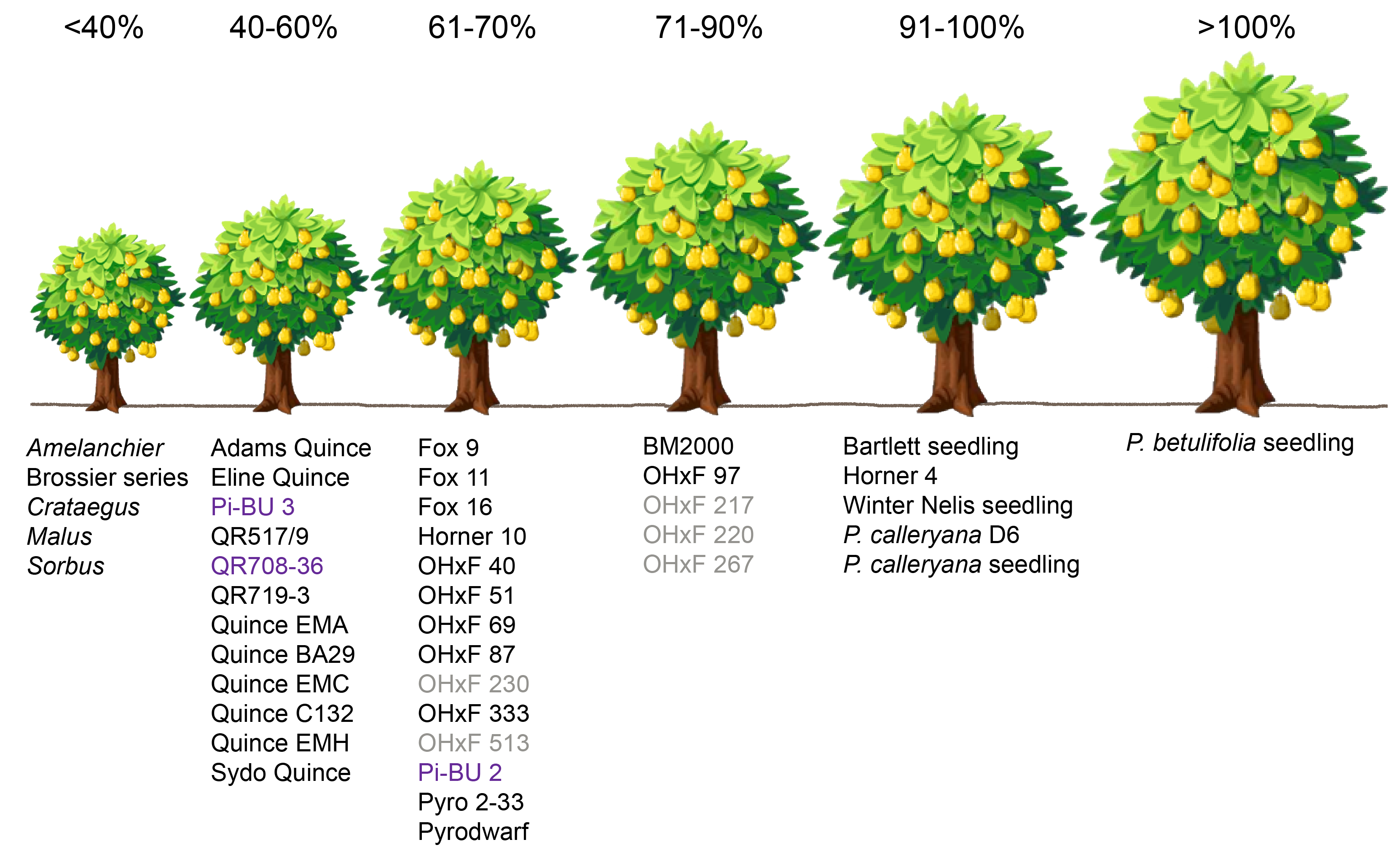
The graphic above illustrates the overall influence on tree size* by various rootstock combinations compared to a Pyrus pear seedling. Key to abbreviations and names: BM = P. communis series from Australia; Brossier = P. nivalis series from Angers, France; Fox = P. communis series from the University of Bologna in Italy; Horner = OHxF clonal series from D. Horner (Oregon nurseryman) and selections by OSU-MCAREC; OHxF = ‘Old Home x Farmingdale’ series; Pi-BU = Pyrus series from Germany; Pyro and Pyrodwarf = P. communis selections from Germany; QR = P. communis selections; ‘Adams’, ‘BA29’, ‘EMC’, ‘EMH’, ‘Sydo’ = Quince dwarfing rootstocks (require interstem for most pear cultivars). Selections shown in gray text indicate antiquated selections no longer in commercial production. Selections shown in purple text indicate possible susceptibility to pear decline. *This general classification of tree size may vary for different cultivars due to cultivar/rootstock interactions. This graphic was adapted from the article by Elkins, Bell & Einhorn, 2012, J. Amer. Pomol. Soc. 66(3):153-163.

The graphic above illustrates the overall influence on tree size* by various rootstock combinations compared to a Pyrus pear seedling. Key to abbreviations and names: BM = P. communis series from Australia; Brossier = P. nivalis series from Angers, France; Fox = P. communis series from the University of Bologna in Italy; Horner = OHxF clonal series from D. Horner (Oregon nurseryman) and selections by OSU-MCAREC; OHxF = ‘Old Home x Farmingdale’ series; Pi-BU = Pyrus series from Germany; Pyro and Pyrodwarf = P. communis selections from Germany; QR = P. communis selections; ‘Adams’, ‘BA29’, ‘EMC’, ‘EMH’, ‘Sydo’ = Quince dwarfing rootstocks (require interstem for most pear cultivars).
Selections shown in gray text indicate antiquated selections no longer in commercial production.
Selections shown in purple text indicate possible susceptibility to pear decline.
*This general classification of tree size may vary for different cultivars due to cultivar/rootstock interactions.
This graphic was adapted from the article by Elkins, Bell, Einhorn, 2012, J. Amer. Pomol. Soc. 66(3):153-163.

Pear varieties growing on OHxF or any Bartlett seedling rootstock tend to be large, non-porous trees. In order to get trees that are more suited to high-density plantings, rootstocks with dwarfing traits and precocity need to be used. In many parts of the world, Quince selections are used as rootstocks. This combination will result in dwarfed growth and precocity. However, Quince is not compatible as a rootstock for many varieties of pear such as Bartlett, Bosc, Forelle, Packham, Triumph, Winter Nellis and Eldorado. For these varieties, the use of an interstock (intermediate graft section) must be used. Another problem with using Quince is that most varieties are not winter hardy making it a poor choice for the Pacific Northwest. However, there are ongoing trials at OSU testing potential Quince selections exhibiting good winter hardiness (Einhorn’s work).

Descriptions of some of the more commonly available pear rootstock.

Bartlett Seedling (Domestic French)
Hardy seedling rootstock Van Well Nursery uses for pear and Asian pear varieties. Source: VanWell Nursery.
Old Home x Farmingdale
‘Old Home’ by ‘Farmingdale’ (OHxF) rootstocks, are a trademark of Carlton Plants. The OHxF series of rootstocks originated from crosses made more than 75 years ago by Reimer at Oregon State University. Reimer was looking primarily for rootstocks resistant to fireblight. Both parents are highly resistant. The work was further developed by Lyle Brooks of Daybreak Nursery and Dr. Mel Westwood at Oregon State University. This superior series of rootstocks are well-anchored and compatible with most varieties. Also, they are winter hardy, precocious and quite productive. Source: Cummins Nursery.
OHxF 40®
A semi-vigorous pear rootstock, about 2/3 standard size.  Resistant to fire blight, crown rot, woolly pear aphids, and pear decline.  Precocious, well-anchored.  Patented with a 50¢ royalty fee. OFxF40 is not very precocious and is not recommended to use with Bosc, which would result in fewer and small fruit. (T. Auvil, WTFRC) Source: Cummins Nursery.
OHxF 87 (Brooks Selection, USPP#6392)
OHxF 87™ makes a tree slightly smaller than Bartlett on seedling root. It is considered a semi-dwarf tree. OHxF 87™ is one of the best producing rootstocks of the OHxF series and was selected for this reason. The OHxF selections are compatible with most pear varieties and are known for their tolerance to blight and decline. Research from Oregon shows OHxF 87™ is an excellent producer. OHxF 87 should be planted 6-8′ between trees within a row. It gives early vigor and is more precocious than OHxF 97. It is also best when paired with a vigorous variety such as Anjou. It is not good for interplanting with less vigorous trees due to competition for light. As a patented selection, OHxF 87™ is available only through selected outlets. Van Well offers this rootstock through a licensing agreement with Carlton Plants, Inc. Source: VanWell Nursery with additional comments by T. Auvil, WFTRC.
OHxF 97
 A clonal rootstock of ‘Old Home’ x ‘Farmingdale’, this rootstock is resistant to pear decline and fireblight. It is a superior rootstock for vigorous pear trees. Hardy and resilient to cold. It provides good anchoring and yield efficiency. It is best planted 8-12′ between trees within a row. OHXF 97 is less precocious than OHxF 87. Source: VanWell Nursery with additional comments by T. Auvil, WFTRC.
OHxF 333
A semi-dwarfing pear rootstock.  It is 1/2 to 2/3 standard size.  Its resistance to fireblight, collar rot, woolly pear aphids, and pear decline make this a very healthy stock.  it is not very precocious and gives few fruit and with reduced size (T. Auvil, WTFRC).  Source: Cummins Nursery
PyroDwarf
PyroDwarf produces a tree  61% – 70% of the size of a seedling pear tree. It is an alternative to seedling rootstocks, as it produces large attractive trees that start bearing usually after 3-4 years. Being of Pyrus origin, there are no graft incompatibility issues with this rootstock. PyroDwarf is able to tolerate chalk / alkaline soils better than quince-derived rootstocks. PyroDwarf was developed from a cross between ‘Old Home’ (fireblight resistance) and ‘Louise Bonne d’Avranches’ (ability to strike hardwood cuttings) pear varieties made by Helmut Jacob, at the Research Institute and College, Geisenheim, Germany, but has only inherited some of the ‘Old Homes’ fireblight resistance. However, it has been reported that this variety produces severe suckering with spiny shoots, as well as causing reduced fruit number (T. Auvil, WTFRC). Source: orangepippinstrees.com.
Sweet Cherry

All commercial cherry trees are made up of two parts: the upper fruiting portion (grafted or budded scion wood); and the lower portion ( the rootstock). Until fairly recently, the majority of breeding efforts were directed towards fruit improvement. Over the past century, breeding programs have concentrated mainly on achieving improved characteristics such as yield, taste, fruit size, fruit firmness, fruit color, precocity, and resistance to fruit cracking and disease. In contrast, rootstock development has only recently received breeders attention. It is believed that ‘Mazzard’ seedlings are the oldest known sweet cherry rootstock dating back to the early Greeks and Romans. And this is still the most widely used rootstock for sweet cherry throughout the Pacific Northwest. Many of the newer rootstocks are described using Mazzard as a standard for comparison. Recently, several new rootstocks have gained prominence for their improved attributes. Many of these are semi-dwarfing. Some of these may impart some disease resistance, induce precocity (bearing younger, and lend themselves to use in high-density plantings. There is an excellent PNW Extension publication by L. Long and C. Kaiser reviewing the performance of the major sweet cherry rootstocks grown around the region. (download pdf PNW619)  Listed below are many of the sweet cherry rootstocks available for use in the Pacific Northwest.
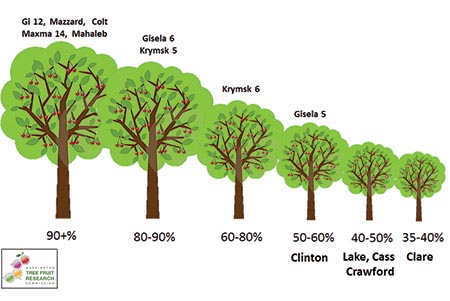
Relative size comparison chart of several rootstocks being evaluated by Michigan State University and Washington State University. More information about this graphic can be found in this Good Fruit Grower article.
Relative size comparison chart of several rootstocks being evaluated by Michigan State University and Washington State University. More information about this graphic can be found in this Good Fruit Grower article.

Listed below are many of the sweet cherry rootstocks available for use in the Pacific Northwest. Click on the heading to view details about each rootstock.

Mazzard (P. avium)
A fibrous root system makes Mazzard a good choice for wet and heavy soils. Mazzard is the most popular cherry rootstock grown in North America. It is generally more vigorous than Mahaleb, especially in poorer soils.
Mahaleb
Performs in deep soils with good drainage. This rootstock is somewhat dwarfing, cold hardy and precocious. Deep rooted. Not recommended for heavy soils or areas with high water tables.
Gisela® 5 (148-2 cv.) USPP #9622
A popular introduction in Germany, this rootstock produces a very precocious tree approximately half the size of trees grown on Mazzard rootstock. It produces an open, spreading tree with wide angles. It is quite virus tolerant and does well in heavy soil. Trees grown on Gisela® 5 may need to be supported. Some suckering may occur depending on growing conditions. It is very hardy and produces well. It is compatible with most varieties. It has shown good results in Washington State.
Gisela® 6 (148-1 cv.) USPP #8954
A semi-dwarf rootstock that produces a tree slightly smaller than Mazzard, roughly 80 to 90 percent. A good substitute for Mazzard, Gisela® 6 is well suited for heavy soil types. The tree structure is very open and round. Very precocious despite its vigor. It appears tolerant to many cherry viruses and is not prone to suckering. Anchors well, but may need support, especially in the first fruiting years because of its precocious nature.
Gisela® 12 (195-2 cv.) USPP #9631
A precocious, semi-dwarf cherry rootstock, yielding a tree about 60% of one grown on Mazzard. Produces a tree that is spreading and open. Resists suckering, is well anchored but may require support.
Colt
Good anchorage and vigor. Heavier soils okay. Clay loam. Very vigorous, smaller than Mazzard. NOT COLD HARDY.
Krymsk® 5 (USSP #15,723)
Reduces tree size by 20% to 30% compared to those grown on Mazzard. Non-suckering trees. The rootstock is precocious and compatible with all cherries. Sensitive to Prunus ringspot & Prunus dwarf virus.
Krymsk® 6 (USPP #16,114)
Reduces tree size by 20% to 30% compared to those grown on Mazzard. Tolerant to water stress and easy to propagate by softwood cuttings. Sensitive to Prunus ringspot & Prunus dwarf virus.
Washington State University